Course outline — 200 minutes across 10 modules
- What Makes You a General Contractor · ≈ 20 min
- Classifications and Limitations · ≈ 20 min
- Financial Responsibility: Your Statements and the Bond Alternative · ≈ 20 min
- The Qualifier — Your License’s Single Point of Failure · ≈ 20 min
- Contracts, Bids and the Payment Chain · ≈ 20 min
- Permits, Inspections and the Lien-Agent Trigger · ≈ 20 min
- Liability Exposure: Discipline, Unlicensed Practice, Injunctions · ≈ 20 min
- The Homeowners Recovery Fund · ≈ 20 min
- Renewal, CE, Inactive Status and Coming Back · ≈ 20 min
- Records, Reporting and Staying in Good Standing · ≈ 20 min
MODULE 9 OF 10 · ESTIMATED 20 MIN
Renewal, CE, Inactive Status and Coming Back
Learning objectives
- State the annual requirement as two mandatory hours plus six elective hours.
- Explain the four-hour elective carry-forward and the January 1 – November 30 window.
- Describe inactive status, what it costs, and what it suspends.
- Apply the reinstatement ladder for licenses invalid one, two, three or four years.
Lesson
DRAFT — pending instructor-of-record approval
The renewal clock, and the sixty days after it
A license expires on the first day of January following its issuance or renewal, and becomes invalid 60 days from that date unless renewed. Those are two different events and the gap between them is the whole point: expiry starts a clock, invalidation ends it. Renewal fees are capped at one hundred twenty-five dollars ($125.00) for an unlimited license, one hundred dollars ($100.00) for intermediate and seventy-five dollars ($75.00) for limited. A renewal application received on or after the first day of January carries a late payment of ten dollars ($10.00) for each month or part of a month after January.
Authority: N.C.G.S. § 87-10(e)
What a renewal has to carry
G.S. 87-10(e) requires two substantive attachments: evidence of continued financial responsibility, and evidence of satisfactory completion of continuing education under G.S. 87-10.2. 21 NCAC 12A .0503(a) fills in the rest of the form — identifying numbers, contact information, the business name, any change in the status of the business since the last renewal, confirmation of limitation and classifications, every crime convicted of since the last renewal with documentation, any disciplinary history with any other occupational licensing agency, an attestation of continued financial responsibility, bond proof where applicable, and the fee with any accrued late fees. Note .0503(d): a corporate license shall not be renewed unless the entity is in good standing with the N.C. Secretary of State.
Authority: N.C.G.S. § 87-10(e) · N.C.G.S. § 87-10.2 ·
Who the CE requirement actually reaches
This is the part most summaries get wrong, and it decides whether continuing education applies to you at all. G.S. 87-10.2(a) imposes the annual eight hours on a licensee holding a BUILDING CONTRACTOR, RESIDENTIAL CONTRACTOR, or UNCLASSIFIED contractor license classification. It is not written to reach every classification. The obligation also runs through the qualifier rather than the entity: at least one qualifier or qualifying party must complete the eight hours, and where a licensee has multiple qualifiers, at least one of them completing it is what keeps the license valid. Two practical consequences follow for a licensee with more than one qualifier. The requirement is not multiplied across them, so paying for four qualifiers to sit eight hours each buys nothing the statute asks for. But it does concentrate risk on whichever qualifier you are relying on, and that person is also the one whose departure starts the 90-day clock from Module 4.
Authority: N.C.G.S. § 87-10.2
Two mandatory, six elective, four carried forward
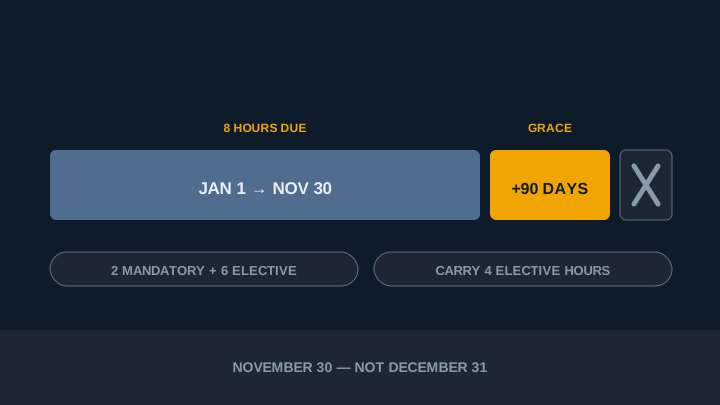
Of the eight annual hours, two are a mandatory course approved by the Board and six are elective courses approved by the Board. Each qualifier shall complete the mandatory course every year — there is no carry-forward on that half. A qualifier may accumulate and carry forward up to four hours of ELECTIVE credit into the next calendar year. 21 NCAC 12B .0102(c) fixes one credit hour at 50 minutes of instructional time, and .0102(b) defines elective subject matter as general business practices relating to general contracting — business planning, contracts, liability exposure, human resources, basic accounting, financial statements, and safety.
Authority:
January 1 to November 30, then a 90-day grace
G.S. 87-10.2(g) sets the year: continuing education requirements begin on January 1 of a calendar year and shall be completed by November 30 of that year. The Board then establishes a 90-day grace period following November 30 for a qualifier who has failed to complete. Failure to satisfy the requirement by the expiration of that grace period results in the entity’s license being invalidated until continuing education and all other licensing requirements have been met. The deadline that matters operationally is November 30, not December 31 — a distinction worth keeping, given that December is also when many providers stop offering courses.
Authority: N.C.G.S. § 87-10.2
E-learning is not a workaround; the statute names it
G.S. 87-10.2(d) opens by saying credit may only be given for courses taught live by an instructor approved by the Board — and then defines “live instruction” to INCLUDE credit hours presented by video, or by internet transmission of a live or previously recorded and approved presentation by an approved instructor, provided the presentation is either proctored by the approved provider or contains safeguards approved by the Board that let the provider certify the qualifier has viewed it. The subsection then directs that the Board shall implement procedures to ensure qualifiers may satisfy ALL of the continuing education requirements through approved internet-based e-learning courses offered by approved providers. Read the whole subsection before concluding that online CE is second-class; the statute contemplates it directly.
Authority: N.C.G.S. § 87-10.2
Inactive status — and it is not free
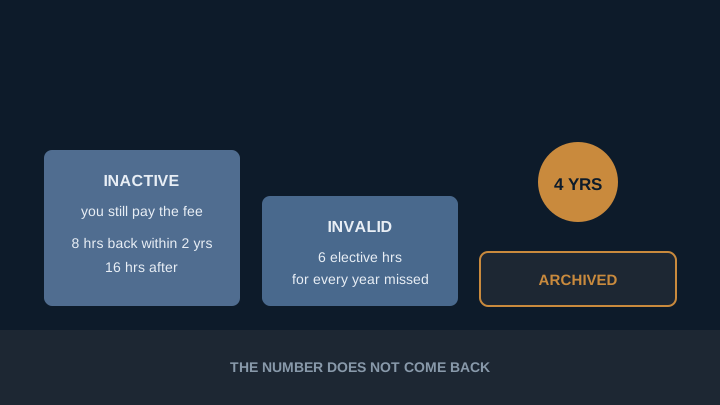
A licensee who chooses not to complete the annual continuing education may annually request that the Board place the license in inactive status, and the license becomes invalid for that license year. The condition attached is the one people miss: to maintain inactive status, the licensee shall pay the same annual renewal fee an active licensee pays. Inactive is a pause on the education and the practice, not on the cost. 21 NCAC 12B .0105 sets out what the application contains, and .0105(b) adds that a licensee on inactive status who fails to renew as of January 1 of the following year goes invalid under Chapter 87 and the 12A rules.
Authority:
Coming back from inactive
G.S. 87-10.2(h) supplies a two-rung ladder, and the rungs are about elapsed time rather than hours owed per year. If the licensee seeks reinstatement during the first two years after the license became inactive, the qualifier shall complete eight hours of continuing education, including the mandatory course offered during the year of reinstatement. If reinstatement is sought more than two years after it became inactive, the qualifier shall complete 16 hours, again including the mandatory course offered in the year of reinstatement. In both cases the current year’s mandatory course is part of the requirement, not additional to it.
Authority: N.C.G.S. § 87-10.2
Coming back from invalid — and the four-year cliff
Invalid is a different state from inactive, and it is more expensive to leave. Under 21 NCAC 12A .0503(f), a licensee whose status is invalid for reasons other than those in G.S. 87-10.2(h) must submit proof of six elective hours of continuing education for EACH year not previously renewed and for the current license year, plus two mandatory hours for the current year. The arithmetic compounds with every year missed. And G.S. 87-10(f) sets the cliff: after a license has been invalid for four years the licensee shall not be permitted to renew it, the license is deemed archived, and archived license numbers shall not be renewed. Relicensing after that means meeting every requirement of a new applicant.
Authority: · N.C.G.S. § 87-10.2 · N.C.G.S. § 87-10(f)
Traducción de cortesía — la versión en inglés es la oficial del curso.
El reloj de la renovación, y los sesenta días que siguen
Una licencia vence el primer día de enero siguiente a su emisión o renovación, y queda inválida a los 60 días de esa fecha si no se renueva. Son dos eventos distintos y la brecha entre ellos es todo el punto: el vencimiento arranca un reloj, la invalidación lo termina. Las cuotas de renovación están topadas en ciento veinticinco dólares ($125.00) para una licencia Unlimited, cien dólares ($100.00) para Intermediate y setenta y cinco dólares ($75.00) para Limited. Una solicitud de renovación recibida el primero de enero o después lleva un recargo por pago tardío de diez dólares ($10.00) por cada mes o fracción de mes posterior a enero.
Qué debe llevar una renovación
La G.S. 87-10(e) exige dos anexos sustantivos: prueba de responsabilidad financiera continuada y prueba de haber completado satisfactoriamente la educación continua conforme a la G.S. 87-10.2. La 21 NCAC 12A .0503(a) completa el resto del formulario — números de identificación, información de contacto, el nombre del negocio, cualquier cambio en el estatus del negocio desde la última renovación, confirmación de la limitación y las clasificaciones, todo delito por el que se haya sido condenado desde la última renovación con su documentación, cualquier historial disciplinario ante cualquier otra agencia de licencias ocupacionales, una atestación de responsabilidad financiera continuada, prueba de fianza cuando aplique, y la cuota con los recargos acumulados. Note la .0503(d): una licencia corporativa no se renovará salvo que la entidad esté en good standing ante el N.C. Secretary of State.
A quién alcanza realmente el requisito de educación continua
Esta es la parte que la mayoría de los resúmenes se equivoca, y decide si la educación continua le aplica a usted siquiera. La G.S. 87-10.2(a) impone las ocho horas anuales al licenciatario que posee una clasificación de licencia de BUILDING CONTRACTOR, RESIDENTIAL CONTRACTOR o contratista UNCLASSIFIED. No está redactada para alcanzar a todas las clasificaciones. La obligación además corre a través del qualifier y no de la entidad: al menos un qualifier o parte calificadora debe completar las ocho horas, y cuando un licenciatario tiene varios qualifiers, que al menos uno de ellos las complete es lo que mantiene válida la licencia. De ahí se siguen dos consecuencias prácticas para el licenciatario con más de un qualifier. El requisito no se multiplica entre ellos, así que pagar para que cuatro qualifiers cursen ocho horas cada uno no compra nada que la ley pida. Pero sí concentra el riesgo en aquel qualifier del que usted depende, y esa persona es también aquella cuya salida arranca el reloj de 90 días del Módulo 4.
Dos obligatorias, seis electivas, cuatro que se arrastran
De las ocho horas anuales, dos corresponden a un curso obligatorio aprobado por la Junta y seis a cursos electivos aprobados por la Junta. Cada qualifier deberá completar el curso obligatorio cada año — en esa mitad no hay arrastre. Un qualifier puede acumular y arrastrar hasta cuatro horas de crédito ELECTIVO al siguiente año calendario. La 21 NCAC 12B .0102(c) fija una hora crédito en 50 minutos de tiempo de instrucción, y la .0102(b) define la materia electiva como prácticas generales de negocio relacionadas con la contratación general — planeación del negocio, contratos, exposición a responsabilidad, recursos humanos, contabilidad básica, estados financieros y seguridad.
Del 1 de enero al 30 de noviembre, y luego una gracia de 90 días
La G.S. 87-10.2(g) fija el año: los requisitos de educación continua comienzan el 1 de enero de un año calendario y deberán completarse a más tardar el 30 de noviembre de ese año. La Junta establece entonces un período de gracia de 90 días posteriores al 30 de noviembre para el qualifier que no haya completado. No satisfacer el requisito al vencer ese período de gracia hace que la licencia de la entidad quede invalidada hasta que se cumplan la educación continua y todos los demás requisitos de licencia. El plazo que importa operativamente es el 30 de noviembre, no el 31 de diciembre — una distinción que conviene retener, dado que diciembre es además cuando muchos proveedores dejan de ofrecer cursos.
El e-learning no es un atajo; la ley lo nombra
La G.S. 87-10.2(d) abre diciendo que solo puede darse crédito por cursos impartidos en vivo por un instructor aprobado por la Junta — y luego define la “live instruction” de modo que INCLUYE las horas crédito presentadas por video, o por transmisión por internet de una presentación en vivo o previamente grabada y aprobada de un instructor aprobado, siempre que la presentación sea supervisada por el proveedor aprobado o contenga salvaguardas aprobadas por la Junta que permitan al proveedor certificar que el qualifier la vio. El inciso dispone después que la Junta implementará procedimientos para asegurar que los qualifiers puedan satisfacer TODOS los requisitos de educación continua mediante cursos de e-learning por internet aprobados y ofrecidos por proveedores aprobados. Lea el inciso completo antes de concluir que la educación continua en línea es de segunda clase; la ley la contempla directamente.
El estatus inactivo — y no es gratis
El licenciatario que opta por no completar la educación continua anual puede solicitar anualmente a la Junta que coloque la licencia en estatus inactivo, y la licencia queda inválida para ese año de licencia. La condición adherida es la que la gente pasa por alto: para mantener el estatus inactivo, el licenciatario deberá pagar la misma cuota anual de renovación que paga un licenciatario activo. Inactivo es una pausa sobre la educación y sobre el ejercicio, no sobre el costo. La 21 NCAC 12B .0105 detalla qué contiene la solicitud, y la .0105(b) agrega que el licenciatario en estatus inactivo que no renueve al 1 de enero del año siguiente queda inválido bajo el Capítulo 87 y las reglas 12A.
Volver desde el estatus inactivo
La G.S. 87-10.2(h) aporta una escalera de dos peldaños, y los peldaños son sobre el tiempo transcurrido y no sobre las horas adeudadas por año. Si el licenciatario busca la reinstalación durante los primeros dos años después de que la licencia quedó inactiva, el qualifier deberá completar ocho horas de educación continua, incluido el curso obligatorio ofrecido durante el año de la reinstalación. Si la reinstalación se busca más de dos años después de haber quedado inactiva, el qualifier deberá completar 16 horas, de nuevo incluido el curso obligatorio ofrecido en el año de la reinstalación. En ambos casos el curso obligatorio del año en curso es parte del requisito, no algo adicional a él.
Volver desde el estatus inválido — y el precipicio de los cuatro años
Inválido es un estado distinto de inactivo, y salir de él cuesta más. Bajo la 21 NCAC 12A .0503(f), el licenciatario cuyo estatus es inválido por razones distintas de las de la G.S. 87-10.2(h) debe presentar prueba de seis horas electivas de educación continua por CADA año no renovado previamente y por el año de licencia en curso, más dos horas obligatorias del año en curso. La aritmética se acumula con cada año perdido. Y la G.S. 87-10(f) fija el precipicio: después de que una licencia ha estado inválida durante cuatro años, no se permitirá al licenciatario renovarla, la licencia se considera archivada, y los números de licencia archivados no se renovarán. Volver a licenciarse después de eso significa cumplir todos los requisitos de un solicitante nuevo.
Authority & state references
- N.C.G.S. § 87-10(e) — Application for license; examination; certificate; renewal — subsection (e) ⏱ ≈ 2 min read
- N.C.G.S. § 87-10(f) — Application for license; examination; certificate; renewal — subsection (f) ⏱ ≈ 2 min read
- N.C.G.S. § 87-10.2 — Continuing education ⏱ ≈ 5 min read
- — Renewal of License ⏱ ≈ 4 min read
- — Continuing Education Credit ⏱ ≈ 2 min read
- — Inactive Status ⏱ ≈ 2 min read
Tap any citation to read it in the statute reader without leaving this page — about 17 minutes of authority reading is available in this module. Time spent here is instructional time: use it if you want more depth, or if you need additional minutes toward the 200-minute course requirement.
Official text opens on the North Carolina General Assembly site (ncleg.gov) — the source of record for every citation. Read-time figures are estimates.
Independent contractor-education provider. Not affiliated with, endorsed by, or acting for the North Carolina Licensing Board for General Contractors. Education, not legal advice — verify current statutes with the NC General Assembly.