Course outline — 200 minutes across 10 modules
- What Makes You a General Contractor · ≈ 20 min
- Classifications and Limitations · ≈ 20 min
- Financial Responsibility: Your Statements and the Bond Alternative · ≈ 20 min
- The Qualifier — Your License’s Single Point of Failure · ≈ 20 min
- Contracts, Bids and the Payment Chain · ≈ 20 min
- Permits, Inspections and the Lien-Agent Trigger · ≈ 20 min
- Liability Exposure: Discipline, Unlicensed Practice, Injunctions · ≈ 20 min
- The Homeowners Recovery Fund · ≈ 20 min
- Renewal, CE, Inactive Status and Coming Back · ≈ 20 min
- Records, Reporting and Staying in Good Standing · ≈ 20 min
MODULE 5 OF 10 · ESTIMATED 20 MIN
Contracts, Bids and the Payment Chain
Learning objectives
- Explain why § 22C-2 makes “pay-when-paid” unenforceable between contracting tiers.
- State the 25% cap on general-contracting work performed under § 87-1.1.
- Distinguish licensed construction management from the development-consultant exclusions.
- Describe the licensure requirements that apply to a joint venture.
Lesson
DRAFT — pending instructor-of-record approval
Where the license question meets the contract
The first four modules dealt with the license as a credential. This one deals with it as a term of business — the places where licensure, or its absence, changes what a contract can do. Three arrive early on almost every project: whether your bid will be considered at all, how far payment can be made contingent on someone else paying, and what structure you are allowed to use when more than one licensed entity is involved. Each is governed by a specific provision, and each has a version that circulates on jobsites that is subtly wrong.
Getting your bid considered — G.S. 87-15
G.S. 87-15 puts a duty on the design side rather than on you. Architects and engineers preparing plans and specifications for work to be contracted in North Carolina must include, in their invitations to bidders and in their specifications, a copy of Article 1 of Chapter 87 or the portions needed to convey to an invited bidder — resident or nonresident, licensed or not — that it will be necessary to show evidence of a license before the bid is considered. The practical read for a contractor is the last clause: evidence of licensure is a precondition to having a bid considered, not a formality to be tidied up after selection.
Authority: N.C.G.S. § 87-15
Pay-if-paid is unenforceable — G.S. 22C-2
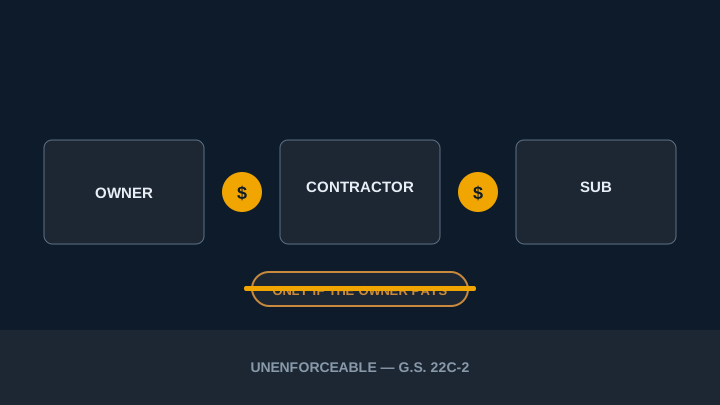
This is the provision most worth knowing precisely, because the loose version costs subcontractors money. G.S. 22C-2 provides that performance by a subcontractor in accordance with its contract entitles it to payment from the party with whom it contracts. Then the operative sentence: payment by the owner to a contractor is not a condition precedent for payment to a subcontractor, and payment by a contractor to a subcontractor is not a condition precedent for payment to any other subcontractor — and an agreement to the contrary is unenforceable. A clause that makes your receipt of owner funds a precondition of paying your sub does not merely fail; it is unenforceable by statute.
Authority: N.C.G.S. § 22C-2
What 22C-2 does not say
Two limits are worth stating plainly, because overreading this section is its own error. First, the statute addresses payment as a condition precedent. It does not, by its terms, abolish every clause that regulates the timing or sequencing of payment; it removes the ability to make upstream payment a prerequisite to the downstream obligation. Second, it speaks to the relationship between the party who contracts and the party performing — payment flows from the party with whom the subcontractor contracts. The practical consequence for a general contractor is that owner non-payment is a risk you hold, not a risk you can pass down by drafting. Price it, insure against it, or manage it through the contract terms that remain available — but do not plan around a contingent-payment clause that the statute will not enforce when it matters.
Authority: N.C.G.S. § 22C-2
The 87-1.1 route, and the cap that lives in a rule
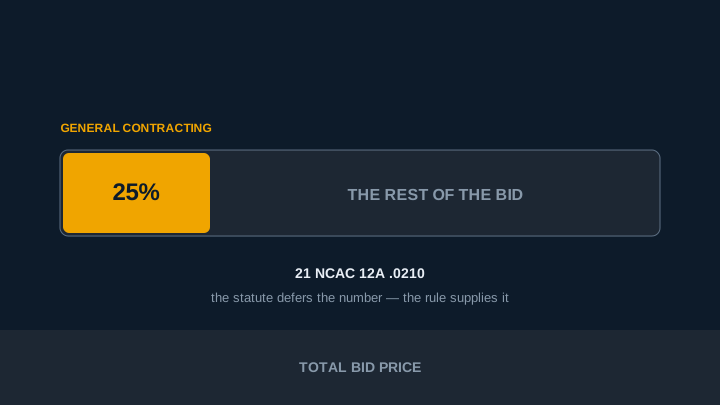
G.S. 87-1.1 lets an electrical licensee under Article 2, or a plumbing, heating and fire sprinkler licensee under Article 4, bid and contract directly with the owner of a building project — provided a licensed general contractor performs all work falling within the G.S. 87-10(b) classifications, and that general contracting work stays within a percentage of the total bid price fixed by Board rule. Note where the number is: the statute defers it, and 21 NCAC 12A .0210 supplies it. If a building project is performed pursuant to G.S. 87-1.1, the total amount of work to be performed by all licensed general contractors shall not exceed 25% of the total bid price. Anyone quoting 25% out of the statute is quoting the wrong document.
Authority: N.C.G.S. § 87-1.1 · N.C.G.S. § 87-10(b) ·
And the cap is not the only condition
.0210 carries a second sentence that is easy to skip: a licensed general contractor shall hold the applicable classifications and limitation for the work that contractor undertakes. The 25% ceiling governs how much general-contracting work the project may contain under this route; it does not relax the classification and limitation rules from Module 2 for whoever performs it. Both tests still apply, to each general contractor, for its own scope. A project can be structured perfectly under 87-1.1 and still put a general contractor outside its license.
Authority: · N.C.G.S. § 87-1.1
Construction management is general contracting — .0208(a)
21 NCAC 12A .0208(a) defines the phrase “undertakes to superintend or manage” from G.S. 87-1. It means being responsible for superintending or managing the construction of an entire project AND either contracting directly with subcontractors to perform the construction, or being compensated for the work based upon the cost of the project or the time taken to complete it. Someone who meets that definition must hold a general contracting license in the classifications and limitation applicable to the project. Calling the role construction management, or program management, does not move it outside the definition — the test is what you are responsible for and how you are paid.
Authority: · N.C.G.S. § 87-1
The development-consultant exclusions, and their conditions
.0208(b) carves out two roles. The first is a North Carolina licensed architect or engineer supervising execution of design plans for the owner who does not contract directly with subcontractors. The second is a consultant, agent or advisor retained by an owner to perform development-related functions — site planning and design, formulating a development scheme, obtaining zoning and entitlements, tenant selection, cost estimates and budgeting, monitoring progress, negotiating with the design and construction team, and similar. But .0208(c) attaches conditions: the owner must have retained a licensed general contractor to construct the entire project or directly superintend all construction work the consultant touches, and the arrangement must not impair the general contractor’s ability to communicate directly with the owner. The general contractor may demand written verification from the owner of any direction given by the consultant — and if the consultant supplies that confirmation itself, the consultant is deemed to be superintending or managing, and the exclusion collapses.
Authority:
Joint ventures — .0207
A joint venture may practice general contracting in North Carolina by either of two routes. Every principal or member of the joint venture is licensed with the appropriate classification and at least one principal holds the appropriate limitation — or the joint venture obtains a general contracting license in its own name under G.S. 87-10 and the Board’s rules. There is a trap for the increasingly common LLC joint venturer: if an LLC is a joint venturer, all members AND managers of that LLC must themselves be licensed with the appropriate classification and limitation. A single unlicensed manager inside a member LLC breaks the structure.
Authority:
Traducción de cortesía — la versión en inglés es la oficial del curso.
Donde la cuestión de la licencia se cruza con el contrato
Los primeros cuatro módulos trataron la licencia como credencial. Este la trata como término de negocio — los lugares donde la licencia, o su ausencia, cambia lo que un contrato puede hacer. Tres aparecen temprano en casi todo proyecto: si su oferta será siquiera considerada, hasta dónde se puede condicionar el pago a que otro pague primero, y qué estructura puede usar cuando participa más de una entidad licenciada. Cada uno está regido por una disposición específica, y de cada uno circula en obra una versión sutilmente equivocada.
Que su oferta sea considerada — G.S. 87-15
La G.S. 87-15 impone un deber al lado del diseño, no a usted. Los arquitectos e ingenieros que preparan planos y especificaciones para obra que se contratará en Carolina del Norte deben incluir, en sus invitaciones a licitar y en sus especificaciones, una copia del Artículo 1 del Capítulo 87 o las porciones necesarias para transmitir al licitante invitado — residente o no residente, licenciado o no — que será necesario mostrar prueba de licencia antes de que su oferta sea considerada. La lectura práctica para un contratista está en la última cláusula: la prueba de licencia es una condición previa para que su oferta sea considerada, no un trámite que se ordena después de la selección.
El pay-if-paid es inexigible — G.S. 22C-2
Esta es la disposición que más conviene conocer con precisión, porque la versión imprecisa les cuesta dinero a los subcontratistas. La G.S. 22C-2 dispone que el cumplimiento del subcontratista conforme a su contrato le da derecho al pago por parte de aquel con quien contrató. Luego viene la oración operativa: el pago del propietario al contratista no es condición previa para el pago al subcontratista, y el pago del contratista a un subcontratista no es condición previa para el pago a ningún otro subcontratista — y un acuerdo en contrario es inexigible. Una cláusula que hace de su recepción de los fondos del propietario una condición previa para pagarle a su subcontratista no solo falla; es inexigible por mandato legal.
Lo que la 22C-2 no dice
Vale la pena enunciar dos límites con claridad, porque sobreleer esta sección es un error por derecho propio. Primero, la ley se ocupa del pago como condición previa. No abole, según su texto, toda cláusula que regule el momento o la secuencia del pago; lo que elimina es la posibilidad de hacer del pago aguas arriba un prerrequisito de la obligación aguas abajo. Segundo, habla de la relación entre quien contrata y quien ejecuta — el pago fluye desde la parte con la que el subcontratista contrató. La consecuencia práctica para un contratista general es que la falta de pago del propietario es un riesgo que usted retiene, no un riesgo que pueda trasladar hacia abajo redactando. Póngale precio, aségurelo, o manéjelo con los términos contractuales que sí quedan disponibles — pero no planifique alrededor de una cláusula de pago condicionado que la ley no hará cumplir cuando importe.
La ruta de la 87-1.1, y el tope que vive en una regla
La G.S. 87-1.1 permite a un licenciatario eléctrico bajo el Artículo 2, o a un licenciatario de plomería, calefacción y rociadores contra incendio bajo el Artículo 4, licitar y contratar directamente con el propietario de un proyecto de edificación — siempre que un contratista general licenciado ejecute todo el trabajo que caiga dentro de las clasificaciones de G.S. 87-10(b), y que ese trabajo de contratación general se mantenga dentro de un porcentaje del precio total de la oferta fijado por regla de la Junta. Fíjese dónde está el número: la ley lo difiere, y la 21 NCAC 12A .0210 lo aporta. Si un proyecto de edificación se ejecuta conforme a G.S. 87-1.1, el monto total del trabajo a ejecutar por todos los contratistas generales licenciados no excederá el 25% del precio total de la oferta. Quien cite el 25% desde la ley está citando el documento equivocado.
Y el tope no es la única condición
La .0210 lleva una segunda oración fácil de saltarse: un contratista general licenciado deberá poseer las clasificaciones y la limitación aplicables al trabajo que ese contratista emprende. El techo del 25% rige cuánto trabajo de contratación general puede contener el proyecto bajo esta ruta; no relaja las reglas de clasificación y limitación del Módulo 2 para quien lo ejecute. Ambas pruebas siguen aplicando, a cada contratista general, sobre su propio alcance. Un proyecto puede estar perfectamente estructurado bajo la 87-1.1 y aun así dejar a un contratista general fuera de su licencia.
La construction management es contratación general — .0208(a)
La 21 NCAC 12A .0208(a) define la frase “undertakes to superintend or manage” de la G.S. 87-1. Significa ser responsable de supervisar o dirigir la construcción de un proyecto entero Y, además, o bien contratar directamente con subcontratistas para ejecutar la construcción, o bien ser remunerado por el trabajo con base en el costo del proyecto o en el tiempo tomado para completarlo. Quien cumpla esa definición debe poseer una licencia de contratación general en las clasificaciones y la limitación aplicables al proyecto. Llamar al papel construction management, o program management, no lo saca de la definición — la prueba es de qué es usted responsable y cómo se le paga.
Las exclusiones del consultor de desarrollo, y sus condiciones
La .0208(b) excluye dos papeles. El primero es el del arquitecto o ingeniero licenciado en Carolina del Norte que supervisa la ejecución de los planos de diseño para el propietario y no contrata directamente con subcontratistas. El segundo es el del consultor, agente o asesor contratado por un propietario para realizar funciones propias del desarrollo — planeación y diseño de sitio, formulación de un esquema de desarrollo, obtención de zonificación y permisos de uso, selección de inquilinos, estimaciones de costo y presupuesto, seguimiento del avance, negociación con el equipo de diseño y construcción, y similares. Pero la .0208(c) impone condiciones: el propietario debe haber contratado a un contratista general licenciado para construir el proyecto entero o para supervisar directamente todo el trabajo de construcción que el consultor toca, y el arreglo no debe menoscabar la capacidad del contratista general de comunicarse directamente con el propietario. El contratista general puede exigir al propietario verificación escrita de cualquier instrucción dada por el consultor — y si es el propio consultor quien aporta esa confirmación, se considera que el consultor está supervisando o dirigiendo, y la exclusión se derrumba.
Joint ventures — .0207
Una joint venture puede ejercer la contratación general en Carolina del Norte por cualquiera de dos rutas. O bien todo principal o miembro de la joint venture está licenciado con la clasificación apropiada y al menos un principal posee la limitación apropiada — o bien la joint venture obtiene una licencia de contratación general a su propio nombre bajo la G.S. 87-10 y las reglas de la Junta. Hay una trampa para el cada vez más común socio LLC: si una LLC es partícipe de la joint venture, todos los miembros Y todos los managers de esa LLC deben estar ellos mismos licenciados con la clasificación y la limitación apropiadas. Un solo manager sin licencia dentro de una LLC miembro rompe la estructura.
Authority & state references
- N.C.G.S. § 87-15 — Copy of Article included in specifications; bid not considered unless contractor licensed ⏱ ≈ 2 min read
- N.C.G.S. § 22C-2 — Performance by subcontractor ⏱ ≈ 2 min read
- — Joint Venture ⏱ ≈ 2 min read
- — Construction Management ⏱ ≈ 4 min read
- — Building Projects ⏱ ≈ 2 min read
- N.C.G.S. § 87-1.1 — Exception for licensees under Article 2 or 4 ⏱ ≈ 3 min read
- N.C.G.S. § 87-10(b) — Application for license; examination; certificate; renewal — subsection (b) ⏱ ≈ 3 min read
Tap any citation to read it in the statute reader without leaving this page — about 18 minutes of authority reading is available in this module. Time spent here is instructional time: use it if you want more depth, or if you need additional minutes toward the 200-minute course requirement.
Official text opens on the North Carolina General Assembly site (ncleg.gov) — the source of record for every citation. Read-time figures are estimates.
Independent contractor-education provider. Not affiliated with, endorsed by, or acting for the North Carolina Licensing Board for General Contractors. Education, not legal advice — verify current statutes with the NC General Assembly.