Course outline — 200 minutes across 10 modules
- What Makes You a General Contractor · ≈ 20 min
- Classifications and Limitations · ≈ 20 min
- Financial Responsibility: Your Statements and the Bond Alternative · ≈ 20 min
- The Qualifier — Your License’s Single Point of Failure · ≈ 20 min
- Contracts, Bids and the Payment Chain · ≈ 20 min
- Permits, Inspections and the Lien-Agent Trigger · ≈ 20 min
- Liability Exposure: Discipline, Unlicensed Practice, Injunctions · ≈ 20 min
- The Homeowners Recovery Fund · ≈ 20 min
- Renewal, CE, Inactive Status and Coming Back · ≈ 20 min
- Records, Reporting and Staying in Good Standing · ≈ 20 min
Required Board notice — takes effect upon course approval (21 NCAC 12B .0301)
“THE NORTH CAROLINA LICENSING BOARD FOR GENERAL CONTRACTORS HAS APPROVED THIS COURSE ONLY AS TO ITS RELEVANCE TO THE PRACTICE OF GENERAL CONTRACTING IN NORTH CAROLINA. THE COURSE PROVIDER AND INSTRUCTOR ARE RESPONSIBLE FOR THE ACCURACY OF THE CONTENT AND COMPLIANCE WITH ALL STATE AND FEDERAL LAWS DURING THE ADMINISTRATION OF THE COURSE.”
Reproduced verbatim for review. It does not yet apply: the Board has not approved this course.
MODULE 1 OF 10 · ESTIMATED 20 MIN
What Makes You a General Contractor
Learning objectives
- State the statutory definition of “general contractor” and the $40,000 cost threshold that triggers it.
- Apply the § 87-1(b) exemptions, including the owner-occupant exemption and its 12-month occupancy presumption.
- Distinguish “cost of the undertaking” and “value” as defined terms rather than everyday words.
Lesson
DRAFT — pending instructor-of-record approval
What the license actually gates
A North Carolina general contractor license is not a credential you carry because the work is large or complicated. It is a permission the State attaches to a specific act: undertaking construction at or above a dollar figure set by statute. That framing matters, because the question a licensee actually faces on a project is never “am I a contractor?” in the abstract. It is “does this particular undertaking require a license, and does mine reach far enough to cover it?” This module answers the first half. The next module answers the second. Get the first half wrong and the consequences are not academic, as the closing section of this module sets out. Everything here turns on two things the General Assembly and the Board have defined for you: a list of verbs, and a dollar figure. Neither is a matter of judgement, and both are narrower than most working definitions of “contractor” that circulate on a jobsite.
The definition, read closely — G.S. 87-1(a)
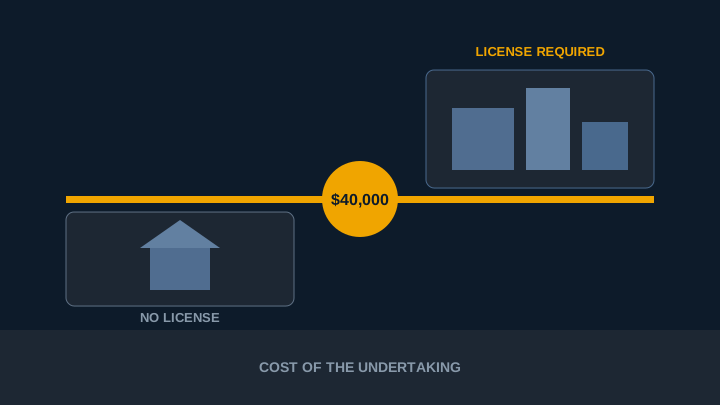
The statute deems you a “general contractor” if, for a fixed price, commission, fee, or wage, you undertake to bid upon, to construct, or to superintend or manage the construction of any building, highway, public utilities project, grading, or any improvement or structure where the cost of the undertaking is forty thousand dollars ($40,000) or more. Read the verbs. Bidding alone is enough — you do not have to win the job, or turn a shovel, to have undertaken it. Superintending or managing is enough, which is why construction managers are inside this definition rather than beside it. The statute also reaches anyone who undertakes to erect a North Carolina labeled manufactured modular building meeting the State Building Code, whatever the price.
Authority: N.C.G.S. § 87-1
$40,000, and what the number is counted from
The threshold is not a rule of thumb and the amount is not left to the ordinary meaning of “cost.” 21 NCAC 12A .0201(2) defines “cost of the undertaking” as the final price of a project, excluding the cost of land, as evidenced by the contract and any subsequent amendments — or, where there is no contract, by permit records, invoices, and cancelled cheques. Three consequences follow. The measure is the final price, not the original bid, so change orders count. Land does not count. And the absence of a written contract does not put you outside the definition; it simply moves the proof onto the paper trail the project generated anyway.
Authority:
“Value” is the same term wearing a different hat
The word “value” appears in G.S. 87-10(a1), where the license limitations live, and it is easy to assume it means something different from the “cost of the undertaking” in G.S. 87-1(a). It does not. 21 NCAC 12A .0201(6) states that “value,” as used in G.S. 87-10(a1), means the same as “cost of the undertaking.” One measure therefore does two jobs: it decides whether a license is required at all, and it decides whether your limitation is wide enough for the job. Note the one place the two provisions differ in wording: G.S. 87-10(a1) excludes both the cost of land and any ancillary costs to improve the land, while .0201(2) speaks only of excluding the cost of land.
Authority: N.C.G.S. § 87-10(a1) · N.C.G.S. § 87-1
The exemptions, and why they are narrow
G.S. 87-1(b) lists three exemptions, and each is drawn tightly. The first covers persons or firms furnishing or erecting industrial equipment, power plant equipment, radial brick chimneys, and monuments — a short, specific list, not a general exemption for equipment installation. The third covers a person engaged in the business of farming who constructs or alters a building on land that person owns and uses in the business of farming, when the building is intended for that person’s use after completion. Both are defined by what the work is and who owns the land, not by how much the job costs. An exemption that fits is complete protection; one that nearly fits is none.
Authority: N.C.G.S. § 87-1
The owner-occupant exemption — two conditions, not one
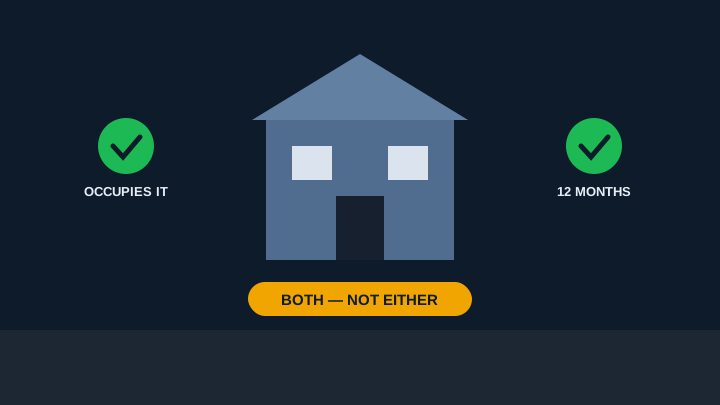
The most-used exemption is G.S. 87-1(b)(2), for someone who constructs or alters a building on land they own. It carries two conditions and both must hold. First, the building must be intended solely for occupancy by that person and their family, firm, or corporation after completion. Second — and this is the condition most often missed — the person must comply with G.S. 87-14, the building-permit provision. An owner who satisfies the occupancy intent but ignores the permit requirements has not met the exemption. The exemption is written as a conjunction, and a licensee advising an owner-builder should read it as one.
Authority: N.C.G.S. § 87-1 · N.C.G.S. § 87-14
The 12-month presumption, and three defined words
G.S. 87-1(b)(2) adds a rule of proof: if the building is not occupied solely by that person and their family, firm, or corporation for at least 12 months following completion, it is presumed the person did not intend it solely for that occupancy — and the exemption falls away retroactively. Three definitions decide how that clock runs. “Completion” occurs on issuance of a certificate of occupancy by the permitting authority (.0201(1)), so the 12 months are counted from the certificate, not from the last day of work. “Solely for occupancy” is restricted to family, the officers and shareholders of a firm or corporation, and guests and social invitees where no consideration is received (.0201(5)). And “family,” for this exemption, means a spouse or other family member living in the same household. An owner-builder who finishes a house and rents it out in month nine has, by operation of the presumption, been building without a license.
Authority: N.C.G.S. § 87-1
Two carve-outs outside § 87-1
Two further provisions sit just outside the definition. G.S. 87-1.1 allows a licensee under Article 2 (electrical) or Article 4 (plumbing, heating, fire sprinkler) to bid and contract directly with the owner of a building project, provided a licensed general contractor performs all work falling within the G.S. 87-10(b) classifications, that general contracting work stays within a percentage of the total bid price fixed by Board rule, and the corresponding limits set by the electrical and plumbing boards are respected. G.S. 87-1.2 removes the licensing requirement for the letting of contracts on the Department of Transportation projects specified in G.S. 136-28.14. Neither is a general escape hatch; both are structured exceptions with their own conditions.
Authority: N.C.G.S. § 87-1 · N.C.G.S. § 87-1.1 · N.C.G.S. § 87-10(b) · N.C.G.S. § 87-1.2
Getting it wrong — the two exposures
Two distinct consequences attach to misjudging this definition, and they run on different tracks. The first is statutory: G.S. 87-13 makes it a criminal offense for a person not duly authorized to contract for or bid upon construction requiring a license, and it reaches presenting another’s license certificate as your own. The second is disciplinary and sits with the Board. 21 NCAC 12A .0201(3) defines “misconduct” under G.S. 87-11 to include allowing an unlicensed person or entity to use a license or examination credential on an undertaking where a license is required — and, separately, allowing a licensed person to use a credential on an undertaking for which the user does not hold the proper classification or limitation. That second limb is the bridge to the next module: lending your license across a classification or limitation line is misconduct even though everyone involved is licensed. The practical rule for a qualifier is that the license follows the work, not the letterhead.
Authority: N.C.G.S. § 87-13 · · N.C.G.S. § 87-11
Traducción de cortesía — la versión en inglés es la oficial del curso.
Lo que realmente controla la licencia
Una licencia de contratista general de Carolina del Norte no es una credencial que uno porta porque el trabajo sea grande o complicado. Es un permiso que el Estado adjunta a un acto específico: emprender una construcción por encima de una cifra fijada por ley. Ese encuadre importa, porque la pregunta que enfrenta un licenciatario en una obra nunca es «¿soy contratista?» en abstracto. Es «¿esta obra en particular requiere licencia, y la mía alcanza para cubrirla?». Este módulo responde la primera mitad. El siguiente responde la segunda. Equivocarse en la primera mitad tiene consecuencias que no son académicas, como expone la sección final de este módulo. Todo aquí depende de dos cosas que la Asamblea General y la Junta ya definieron por usted: una lista de verbos y una cifra en dólares. Ninguna de las dos es cuestión de criterio, y ambas son más estrechas que la mayoría de las definiciones de «contratista» que circulan en una obra.
La definición, leída de cerca — G.S. 87-1(a)
La ley lo considera «contratista general» si, por un precio fijo, comisión, honorario o salario, usted emprende ofertar, construir, o supervisar o administrar la construcción de cualquier edificio, carretera, obra de servicios públicos, nivelación, o cualquier mejora o estructura donde el costo de la obra sea de cuarenta mil dólares ($40,000) o más. Lea los verbos. Ofertar por sí solo basta — no hace falta ganar el trabajo, ni mover una pala, para haberlo emprendido. Supervisar o administrar basta, y por eso los gerentes de construcción quedan dentro de esta definición y no al margen de ella. La ley también alcanza a quien emprenda erigir un edificio modular prefabricado etiquetado de Carolina del Norte que cumpla con el State Building Code, cualquiera sea el precio.
$40,000, y desde dónde se cuenta la cifra
El umbral no es una regla general y el monto no queda librado al sentido común de «costo». 21 NCAC 12A .0201(2) define «cost of the undertaking» como el precio final de un proyecto, excluyendo el costo del terreno, según lo evidencie el contrato y sus modificaciones posteriores — o, cuando no hay contrato, los registros de permisos, las facturas y los cheques cancelados. De ahí se siguen tres consecuencias. La medida es el precio final, no la oferta original, así que las órdenes de cambio cuentan. El terreno no cuenta. Y la ausencia de un contrato escrito no lo deja fuera de la definición; simplemente traslada la prueba al rastro documental que el proyecto generó de todos modos.
«Value» es el mismo término con otro sombrero
La palabra «value» aparece en G.S. 87-10(a1), donde viven las limitaciones de la licencia, y es fácil suponer que significa algo distinto del «cost of the undertaking» de G.S. 87-1(a). No es así. 21 NCAC 12A .0201(6) establece que «value», tal como se usa en G.S. 87-10(a1), significa lo mismo que «cost of the undertaking». Una sola medida cumple entonces dos funciones: decide si se requiere licencia, y decide si su limitación alcanza para el trabajo. Note el único punto donde las dos disposiciones difieren en su redacción: G.S. 87-10(a1) excluye tanto el costo del terreno como cualquier costo accesorio para mejorarlo, mientras que .0201(2) habla solo de excluir el costo del terreno.
Las exenciones, y por qué son estrechas
G.S. 87-1(b) enumera tres exenciones, y cada una está redactada de forma ajustada. La primera cubre a personas o firmas que suministren o erijan equipo industrial, equipo de plantas de energía, chimeneas radiales de ladrillo y monumentos — una lista corta y específica, no una exención general para la instalación de equipos. La tercera cubre a quien se dedique al negocio agropecuario y construya o altere un edificio en terreno de su propiedad usado en ese negocio, cuando el edificio esté destinado a su propio uso tras la finalización. Ambas se definen por qué es el trabajo y quién es dueño del terreno, no por cuánto cuesta la obra. Una exención que encaja es protección completa; una que casi encaja no es ninguna.
La exención del propietario-ocupante — dos condiciones, no una
La exención más usada es la de G.S. 87-1(b)(2), para quien construye o altera un edificio en terreno de su propiedad. Trae dos condiciones y ambas deben cumplirse. Primera, el edificio debe estar destinado exclusivamente a ser ocupado por esa persona y su familia, firma o corporación tras la finalización. Segunda — y esta es la que más se pasa por alto — la persona debe cumplir con G.S. 87-14, la disposición sobre permisos de construcción. Un propietario que satisface la intención de ocupación pero ignora los requisitos de permiso no ha cumplido la exención. Está redactada como una conjunción, y un licenciatario que asesore a un propietario-constructor debería leerla así.
La presunción de 12 meses, y tres palabras definidas
G.S. 87-1(b)(2) agrega una regla de prueba: si el edificio no es ocupado exclusivamente por esa persona y su familia, firma o corporación durante al menos 12 meses después de la finalización, se presume que la persona no tenía la intención de destinarlo exclusivamente a esa ocupación — y la exención cae retroactivamente. Tres definiciones deciden cómo corre ese reloj. La «finalización» ocurre al emitirse un certificado de ocupación por la autoridad que otorga permisos (.0201(1)), de modo que los 12 meses se cuentan desde el certificado, no desde el último día de trabajo. «Solely for occupancy» se limita a la familia de una persona, los directivos y accionistas de una firma o corporación, y huéspedes e invitados sociales cuando no se recibe contraprestación (.0201(5)). Y «family», para esta exención, significa un cónyuge u otro familiar que viva en el mismo hogar. Un propietario-constructor que termina una casa y la alquila en el mes nueve ha estado construyendo sin licencia, por obra de la presunción.
Dos excepciones fuera de § 87-1
Dos disposiciones más quedan justo afuera de la definición. G.S. 87-1.1 permite que un licenciatario bajo el Article 2 (eléctrico) o el Article 4 (plomería, calefacción, rociadores contra incendios) oferte y contrate directamente con el propietario de un proyecto de edificación, siempre que un contratista general licenciado ejecute todo el trabajo comprendido en las clasificaciones de G.S. 87-10(b), que ese trabajo de contratación general se mantenga dentro de un porcentaje del precio total de la oferta fijado por regla de la Junta, y que se respeten los límites correspondientes fijados por las juntas de electricidad y plomería. G.S. 87-1.2 elimina el requisito de licencia para la adjudicación de contratos en los proyectos del Department of Transportation especificados en G.S. 136-28.14. Ninguna es una vía de escape general; ambas son excepciones estructuradas con sus propias condiciones.
Equivocarse — las dos exposiciones
Dos consecuencias distintas se derivan de juzgar mal esta definición, y corren por carriles diferentes. La primera es legal: G.S. 87-13 tipifica como delito menor que una persona no debidamente autorizada contrate u oferte por una construcción que requiere licencia, y alcanza también a presentar el certificado de licencia de otro como propio. La segunda es disciplinaria y corresponde a la Junta. 21 NCAC 12A .0201(3) define «misconduct» bajo G.S. 87-11 de modo que incluye permitir que una persona o entidad sin licencia use una licencia o credencial de examen en una obra donde se requiere licencia — y, por separado, permitir que una persona licenciada use una credencial en una obra para la cual no tiene la clasificación o limitación adecuada. Ese segundo supuesto es el puente al módulo siguiente: prestar su licencia cruzando una línea de clasificación o limitación es conducta indebida aunque todos los involucrados estén licenciados. La regla práctica para un calificador es que la licencia sigue al trabajo, no al membrete.
Authority & state references
- N.C.G.S. § 87-1 — "General contractor" defined; exceptions ⏱ ≈ 6 min read
- N.C.G.S. § 87-1.1 — Exception for licensees under Article 2 or 4 ⏱ ≈ 3 min read
- N.C.G.S. § 87-1.2 — Exception for specified Department of Transportation contractors ⏱ ≈ 2 min read
- — Definitions ⏱ ≈ 3 min read
- N.C.G.S. § 87-13 — Unauthorized practice of contracting; penalties ⏱ ≈ 3 min read
- N.C.G.S. § 87-11 — Revocation of license; charges of fraud, negligence, incompetency, etc.; hearing thereon; reissuance of certificate ⏱ ≈ 4 min read
Tap any citation to read it in the statute reader without leaving this page — about 21 minutes of authority reading is available in this module. Time spent here is instructional time: use it if you want more depth, or if you need additional minutes toward the 200-minute course requirement.
Official text opens on the North Carolina General Assembly site (ncleg.gov) — the source of record for every citation. Read-time figures are estimates.
Independent contractor-education provider. Not affiliated with, endorsed by, or acting for the North Carolina Licensing Board for General Contractors. Education, not legal advice — verify current statutes with the NC General Assembly.