Course outline — 200 minutes across 10 modules
- What Makes You a General Contractor · ≈ 20 min
- Classifications and Limitations · ≈ 20 min
- Financial Responsibility: Your Statements and the Bond Alternative · ≈ 20 min
- The Qualifier — Your License’s Single Point of Failure · ≈ 20 min
- Contracts, Bids and the Payment Chain · ≈ 20 min
- Permits, Inspections and the Lien-Agent Trigger · ≈ 20 min
- Liability Exposure: Discipline, Unlicensed Practice, Injunctions · ≈ 20 min
- The Homeowners Recovery Fund · ≈ 20 min
- Renewal, CE, Inactive Status and Coming Back · ≈ 20 min
- Records, Reporting and Staying in Good Standing · ≈ 20 min
MODULE 6 OF 10 · ESTIMATED 20 MIN
Permits, Inspections and the Lien-Agent Trigger
Learning objectives
- State what a permit applicant must prove about licensure and workers’ compensation.
- Identify when a lien agent must be designated and named on the permit.
- Explain the owner-exemption affidavit and the consequences of claiming it wrongly.
- Describe the licensee’s duty to obtain permits and see inspections through to compliance.
Lesson
DRAFT — pending instructor-of-record approval
The permit desk is a license checkpoint
Most of what this course has covered is enforced after the fact — by the Board, on complaint, sometimes years later. The building permit is different. It is the one moment in a project where someone is required to verify your licensure before work starts, and where the law tells a public official to refuse you if you cannot show it. That makes the permit application worth understanding as a compliance event rather than an administrative errand, and it makes the licensee’s permit duties in 21 NCAC 12A .0212 among the easiest rules in the chapter to breach without meaning to.
Authority:
Nothing starts without the permit — G.S. 160D-1110
G.S. 160D-1110(a) provides that no person shall commence or proceed with construction, reconstruction, alteration, repair, movement to another site, removal or demolition of any building or structure — or with the installation, extension or general repair of plumbing, heating and electrical systems — without first securing all permits required by the North Carolina State Building Code and any other applicable State or local law. The section carries its own narrow exceptions, but the default is unambiguous: securing the permit precedes commencing the work, not merely completing it.
Authority: N.C.G.S. § 160D-1110
What the applicant must prove — licensure
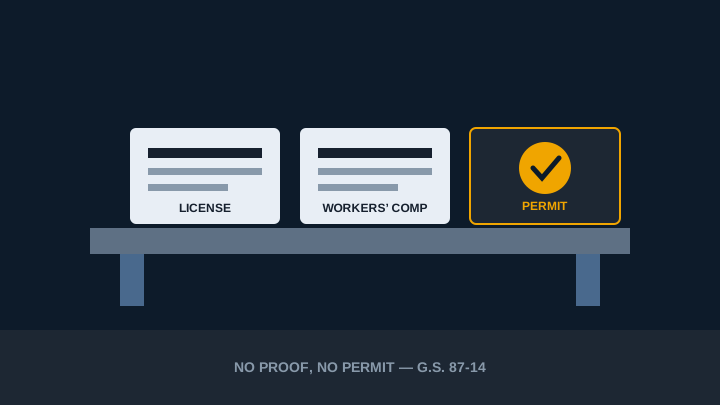
G.S. 87-14(a)(1) requires a permit applicant to furnish proof that the person who will carry out or superintend the construction is licensed under Article 1, or is exempt from licensure under G.S. 87-1(b). G.S. 87-14(b) closes the loop from the other side: it is unlawful for the building inspector or other authority to issue, or allow the issuance of, a building permit unless and until the applicant has furnished that evidence. The duty is not only yours — the official has one too, and an issued permit does not cure an applicant who was never entitled to it. Treat a permit that issued without the proof having been furnished as a defect on the project, not as a piece of good fortune to be left alone.
Authority: N.C.G.S. § 87-14 · N.C.G.S. § 87-1
The owner-exemption affidavit
Where an applicant claims the owner-occupant exemption under G.S. 87-1(b)(2) — the exemption Module 1 examined — the statute does not take their word for it. The applicant must execute a verified affidavit attesting that they own the property on which the building is being constructed and, where the applicant is a firm or corporation, that the person submitting the application is an owner, officer or member of it. The consequence of getting this wrong is specific: if the Board determines the applicant was not entitled to claim the exemption, the building permit shall be revoked pursuant to G.S. 160D-1115. A revoked permit mid-project is a materially worse outcome than never having claimed the exemption.
Authority: N.C.G.S. § 87-1
And workers’ compensation
G.S. 87-14(a)(2) adds a second proof: the applicant must furnish proof of Workers’ Compensation insurance in effect as required by Chapter 97 of the General Statutes. It sits in the same list as the licensure proof and is checked at the same counter. For a licensee whose coverage lapses between projects, this is where the lapse surfaces — at the permit desk, on the day the schedule assumed work would start. Two practical habits follow. Keep the certificate somewhere the permit clerk can be handed it rather than emailed it a day later, and treat the policy renewal date as a project-schedule date, because at a permit desk it functions as one.
Authority: N.C.G.S. § 87-14
The lien agent trigger — $40,000, with two exceptions
G.S. 87-14(a1) requires a permit applicant to provide the building inspector with the name, physical and mailing address, telephone number, facsimile number and email address of the lien agent the owner designated under G.S. 44A-11.1(a). It applies to any improvements for which the combined cost is forty thousand dollars ($40,000) or more, with two carve-outs: improvements to an existing single-family residential dwelling unit, as defined in G.S. 87-15.5(7), that the owner occupies as a residence; and the addition of an accessory building or structure, as defined in the Residential Building Code, whose use is incidental to that dwelling unit.
Authority: N.C.G.S. § 87-14 · N.C.G.S. § 87-15.5
One number, two different jobs
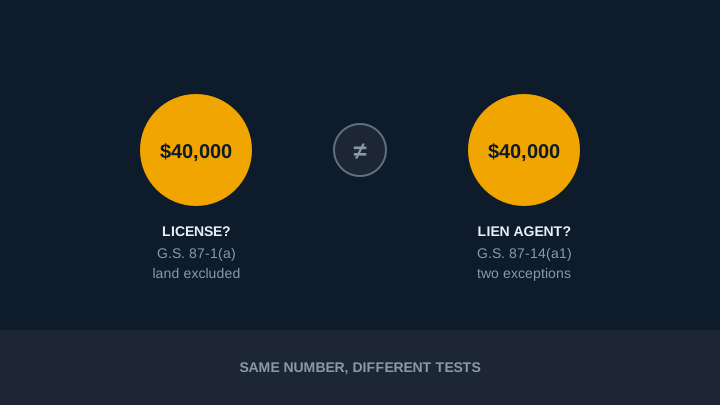
The $40,000 in G.S. 87-14(a1) is the same figure as the licensure threshold in G.S. 87-1(a), and that coincidence causes real confusion. They are separate tests. The licensure threshold asks whether the cost of the undertaking requires a licensed general contractor, measured as .0201(2) defines it and excluding land. The lien-agent trigger asks whether the combined cost of improvements requires a lien agent to be designated and named on the permit, and it carries the owner-occupied and accessory-structure exceptions that the licensure test does not. A project can sit on one side of one line and the other side of the other. The safe habit is to run both tests separately on every job, rather than deciding once that a project is over forty thousand and carrying that single conclusion into two different questions.
Authority: N.C.G.S. § 87-14 · N.C.G.S. § 87-1
Your duties after the permit issues — .0212(a)
21 NCAC 12A .0212(a) is short and demanding. A licensee shall obtain all necessary building permits from the local Code Enforcement Agency before commencing any work requiring one. Having obtained them, the licensee shall obtain all required inspections and assure that every inspection required by Building Code Council codes is passed. Then the sentence that catches people: absent a written acknowledgement by a local Code Enforcement Official, a licensee is not relieved of responsibility to complete all required inspections until a certificate of compliance or its equivalent is obtained. Walking off a substantially complete job without closing out inspections leaves the duty running, and G.S. 160D-1113 has inspectors making as many inspections as necessary while work progresses, with a right of entry at reasonable hours on presentation of credentials.
Authority: · N.C.G.S. § 160D-1113
Never lend the permit — .0212(b) and (c)
.0212(b) prohibits a licensee from allowing a building permit to be obtained, or allowing their license number to appear on a permit application, unless the licensee owns the property or has an agreement with the property owner or the owner’s designee to perform the work described in the permit. Paragraph (c) supplies the teeth: failure to comply with the Rule constitutes misconduct as described in G.S. 87-11. This is the permit-desk face of the license-lending problem from Module 1, and it is disciplinable whether or not the work is ever performed badly. One related consequence sits in G.S. 160D-1113: where a permit was obtained by an owner exempt under G.S. 87-1(b)(2), no inspection may be conducted without the owner personally present, unless the plans were drawn and sealed by a licensed architect.
Authority: · N.C.G.S. § 87-11 · N.C.G.S. § 160D-1113 · N.C.G.S. § 87-1
Traducción de cortesía — la versión en inglés es la oficial del curso.
La ventanilla de permisos es un punto de control de licencias
Casi todo lo que este curso ha cubierto se hace cumplir después del hecho — por la Junta, ante una queja, a veces años más tarde. El permiso de construcción es distinto. Es el único momento del proyecto en que alguien está obligado a verificar su licencia antes de que la obra empiece, y donde la ley le dice a un funcionario público que lo rechace si usted no puede mostrarla. Eso hace que valga la pena entender la solicitud de permiso como un evento de cumplimiento y no como un trámite administrativo, y hace que los deberes del licenciatario en materia de permisos de 21 NCAC 12A .0212 estén entre las reglas del capítulo más fáciles de infringir sin querer.
Nada comienza sin el permiso — G.S. 160D-1110
La G.S. 160D-1110(a) dispone que ninguna persona iniciará ni continuará la construcción, reconstrucción, alteración, reparación, traslado a otro sitio, remoción o demolición de cualquier edificio o estructura — ni la instalación, extensión o reparación general de sistemas de plomería, calefacción y eléctricos — sin antes obtener todos los permisos exigidos por el North Carolina State Building Code y por cualquier otra ley estatal o local aplicable. La sección lleva sus propias excepciones estrechas, pero la regla por defecto no es ambigua: obtener el permiso precede a iniciar la obra, no solamente a terminarla.
Lo que el solicitante debe probar — la licencia
La G.S. 87-14(a)(1) exige que el solicitante del permiso aporte prueba de que la persona que ejecutará o supervisará la construcción está licenciada bajo el Artículo 1, o está exenta de licencia bajo la G.S. 87-1(b). La G.S. 87-14(b) cierra el circuito desde el otro lado: es ilícito que el inspector de construcción u otra autoridad emita, o permita la emisión de, un permiso de construcción a menos que y hasta que el solicitante haya aportado esa prueba. El deber no es solo suyo — el funcionario también tiene uno, y un permiso emitido no sana a un solicitante que nunca tuvo derecho a él. Trate un permiso que se emitió sin que la prueba se hubiera aportado como un defecto del proyecto, no como un golpe de suerte que conviene no tocar.
La declaración jurada de la exención del propietario
Cuando un solicitante invoca la exención del propietario-ocupante bajo la G.S. 87-1(b)(2) — la exención que examinó el Módulo 1 — la ley no le cree bajo palabra. El solicitante debe otorgar una declaración jurada verificada en la que atestigüe que es dueño del inmueble donde se construye el edificio y, cuando el solicitante es una firma o corporación, que quien presenta la solicitud es propietario, funcionario o miembro de ella. La consecuencia de equivocarse aquí es específica: si la Junta determina que el solicitante no tenía derecho a invocar la exención, el permiso de construcción será revocado conforme a la G.S. 160D-1115. Un permiso revocado a mitad de proyecto es un resultado materialmente peor que no haber invocado nunca la exención.
Y el seguro de compensación laboral
La G.S. 87-14(a)(2) agrega una segunda prueba: el solicitante debe aportar prueba de que el seguro de Workers’ Compensation está vigente según lo exige el Capítulo 97 de los General Statutes. Está en la misma lista que la prueba de licencia y se revisa en el mismo mostrador. Para el licenciatario cuya cobertura caduca entre proyectos, aquí es donde el lapso sale a la luz — en la ventanilla de permisos, el día en que el cronograma suponía que la obra arrancaba. De ahí se siguen dos hábitos prácticos. Tenga el certificado en algún lugar desde donde pueda entregárselo al empleado del permiso en mano, no enviárselo por correo un día después, y trate la fecha de renovación de la póliza como una fecha del cronograma del proyecto, porque en una ventanilla de permisos funciona como tal.
El disparador del agente de gravámenes — $40,000, con dos excepciones
La G.S. 87-14(a1) exige que el solicitante del permiso proporcione al inspector de construcción el nombre, la dirección física y postal, el teléfono, el número de fax y el correo electrónico del agente de gravámenes que el propietario designó bajo la G.S. 44A-11.1(a). Aplica a cualquier mejora cuyo costo combinado sea de cuarenta mil dólares ($40,000) o más, con dos exclusiones: las mejoras a una unidad de vivienda residencial unifamiliar existente, según la define la G.S. 87-15.5(7), que el propietario ocupa como residencia; y la adición de un edificio o estructura accesoria, según la define el Residential Building Code, cuyo uso es incidental a esa unidad de vivienda.
Un mismo número, dos trabajos distintos
Los $40,000 de la G.S. 87-14(a1) son la misma cifra que el umbral de licencia de la G.S. 87-1(a), y esa coincidencia causa confusión real. Son pruebas separadas. El umbral de licencia pregunta si el costo de la obra requiere un contratista general licenciado, medido como lo define la .0201(2) y excluyendo el terreno. El disparador del agente de gravámenes pregunta si el costo combinado de las mejoras obliga a designar un agente de gravámenes y a nombrarlo en el permiso, y lleva las excepciones de propietario-ocupante y de estructura accesoria que la prueba de licencia no tiene. Un proyecto puede quedar de un lado de una línea y del otro lado de la otra. El hábito seguro es correr ambas pruebas por separado en cada obra, en vez de decidir una sola vez que un proyecto supera los cuarenta mil y arrastrar esa única conclusión a dos preguntas distintas.
Sus deberes después de que se emite el permiso — .0212(a)
La 21 NCAC 12A .0212(a) es breve y exigente. El licenciatario obtendrá todos los permisos de construcción necesarios de la Code Enforcement Agency local antes de comenzar cualquier trabajo que requiera uno. Habiéndolos obtenido, el licenciatario obtendrá todas las inspecciones requeridas y se asegurará de que toda inspección exigida por los códigos del Building Code Council sea aprobada. Luego viene la oración que atrapa a la gente: a falta de un reconocimiento escrito de un Code Enforcement Official local, el licenciatario no queda relevado de la responsabilidad de completar todas las inspecciones requeridas hasta obtener un certificado de cumplimiento o su equivalente. Retirarse de una obra sustancialmente terminada sin cerrar las inspecciones deja el deber corriendo, y la G.S. 160D-1113 dispone que los inspectores hagan tantas inspecciones como sean necesarias mientras la obra avanza, con derecho de entrada a horas razonables presentando sus credenciales.
Nunca preste el permiso — .0212(b) y (c)
La .0212(b) prohíbe al licenciatario permitir que se obtenga un permiso de construcción, o permitir que su número de licencia aparezca en una solicitud de permiso, salvo que el licenciatario sea dueño del inmueble o tenga un acuerdo con el propietario o su designado para ejecutar el trabajo descrito en el permiso. El párrafo (c) aporta los dientes: el incumplimiento de la Regla constituye conducta indebida según la describe la G.S. 87-11. Esta es la cara de ventanilla del problema del préstamo de licencia del Módulo 1, y es sancionable se ejecute o no mal la obra. Una consecuencia relacionada está en la G.S. 160D-1113: cuando un permiso fue obtenido por un propietario exento bajo la G.S. 87-1(b)(2), no puede realizarse inspección alguna sin que el propietario esté personalmente presente, salvo que los planos hayan sido elaborados y sellados por un arquitecto licenciado.
Authority & state references
- N.C.G.S. § 87-14 — Regulations as to issue of building permits ⏱ ≈ 4 min read
- N.C.G.S. § 160D-1110 — Building permits ⏱ ≈ 9 min read
- N.C.G.S. § 160D-1113 — Inspections of work in progress ⏱ ≈ 2 min read
- — Permits And Inspections ⏱ ≈ 2 min read
- N.C.G.S. § 87-1 — "General contractor" defined; exceptions ⏱ ≈ 6 min read
- — Definitions ⏱ ≈ 3 min read
- N.C.G.S. § 87-11 — Revocation of license; charges of fraud, negligence, incompetency, etc.; hearing thereon; reissuance of certificate ⏱ ≈ 4 min read
Tap any citation to read it in the statute reader without leaving this page — about 30 minutes of authority reading is available in this module. Time spent here is instructional time: use it if you want more depth, or if you need additional minutes toward the 200-minute course requirement.
Official text opens on the North Carolina General Assembly site (ncleg.gov) — the source of record for every citation. Read-time figures are estimates.
Independent contractor-education provider. Not affiliated with, endorsed by, or acting for the North Carolina Licensing Board for General Contractors. Education, not legal advice — verify current statutes with the NC General Assembly.