Course outline — 100 minutes across 6 modules
- Why Liens Exist — the Chapter 44A Toolkit · ≈ 17 min
- The Lien Agent: Designation and the $40,000 Threshold · ≈ 17 min
- Information Flows: Who Must Tell Whom, and When · ≈ 16 min
- Perfecting the Claim: 120 Days, the Right Courthouse · ≈ 17 min
- Enforcement, Priority, and the Clock · ≈ 16 min
- Lien Risk Management for the Licensed GC · ≈ 17 min
MODULE 5 OF 6 · ESTIMATED 16 MIN
Enforcement, Priority, and the Clock
Learning objectives
- State the deadline for commencing an action to enforce a claim of lien on real property.
- Explain relation back — the priority date a perfected North Carolina lien takes.
- Assemble the full lien timeline from first furnishing through enforcement.
Lesson
DRAFT — pending instructor-of-record approval
Filing is not the finish line
A filed claim of lien clouds title, but it does not collect money by itself. The second — and final — deadline of North Carolina lien practice is enforcement: under § 44A-13, an ACTION to enforce the claim of lien on real property must be COMMENCED within 180 DAYS of the claimant’s last furnishing of labor or materials. Read the reference point carefully: like the 120-day filing deadline, the 180-day enforcement clock runs from LAST FURNISHING — not from the date the claim of lien was filed. The two deadlines are nested clocks started by the same event. A claimant who files its claim on day 119 has not bought itself six more months of thinking time; it has 61 days left to sue.
Authority: N.C.G.S. § 44A-13
The complete timeline
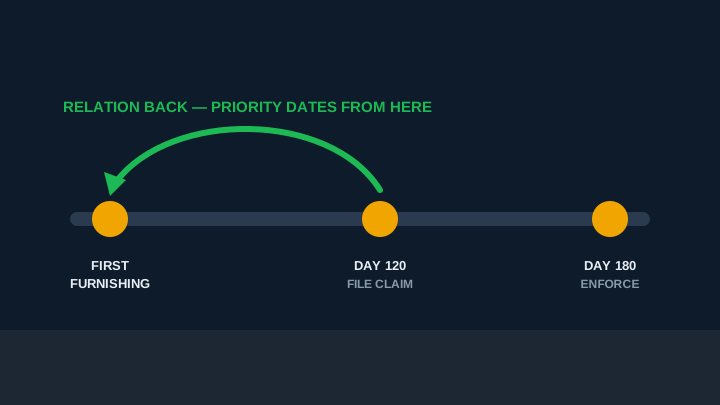
Put the whole machine on one line. Project setup: owner designates the lien agent (no later than first contract; $40,000-or-more projects, module 2). Mobilization: contractors and subs file their notices to the lien agent (module 3). Day zero for YOUR remedies: your last furnishing of labor or materials. Day 120 outer limit: claim of lien on real property filed with the clerk of superior court (module 4). Day 180 outer limit: enforcement action commenced. Miss the first deadline and there is nothing to enforce; meet the first and miss the second and the perfected lien dies of old age. Every date is knowable in advance, which is why lien practice belongs on your project calendar, not in your crisis playbook.
Authority: N.C.G.S. § 44A-11.1 · N.C.G.S. § 44A-11.2 · N.C.G.S. § 44A-12 · N.C.G.S. § 44A-13
Relation back — why lien priority is stronger than it looks
Here is the feature that makes the mechanics’ lien a genuinely powerful security device. A perfected North Carolina claim of lien on real property RELATES BACK: it takes effect not from its filing date but from the date of the claimant’s FIRST furnishing of labor or materials at the site. Think about what that means against competing interests in the land. A lien filed in October by a grading contractor who first furnished in February takes its place in line as of February. Interests recorded against the property in the months between — later financing, for example — find themselves junior to a lien they could not see when they recorded, because the lien had not been filed yet. That invisible seniority is precisely the risk the lien-agent system of modules 2 and 3 was built to manage: early notice makes the future lien visible even though nothing is yet on record at the courthouse. Relation back is why title insurers care so much about the LiensNC record — and why your early notice, filed in module 3, quietly anchored the best priority date you will ever have on the project.
Authority: N.C.G.S. § 44A-10
Enforcement in practice
Commencing the enforcement action converts the recorded claim into a judicial foreclosure proceeding against the property interest — the endgame that forces resolution. In the real world, the overwhelming majority of perfected liens never reach a courthouse verdict: the cloud on title plus an approaching enforcement deadline is usually enough to produce payment, settlement, or a negotiated release, because the owner needs clean title more than it needs the dispute. That is why the disciplined claimant files early and calendars the 180-day date immediately: each remaining week inside the window is negotiating leverage. Conversely, when YOU are the one receiving a lien threat — as GC, or passing one through to an owner — the same clocks tell you exactly how much time the claimant really has, and whether the threat is live or already expired.
Authority: N.C.G.S. § 44A-13
Worked example — relation back in a priority contest
Relation back decides fights that filing dates alone would lose. A grading contractor first moves dirt on February 8. In May the owner refinances and the new lender records its deed of trust. Payment fails; the grader files its claim of lien on June 20 and commences enforcement in early August. Read the calendar the way the statute does: the lien, once perfected, takes effect from the claimant’s FIRST furnishing — February 8 — which is months before the lender recorded. The lender’s title search in May found nothing at the courthouse, because there was nothing yet to find. That invisible seniority is exactly why the lien-agent system exists: the notices of module 3 make a future claimant visible while the project is live, so a lender or title insurer can price the risk instead of discovering it. Early notice protects everyone, including you.
Authority: N.C.G.S. § 44A-10 · N.C.G.S. § 44A-12 · N.C.G.S. § 44A-13
Clearing the cloud
Liens end in one of a few ways: the debt is paid or settled and the claim is released; the claimant lets a deadline lapse and the encumbrance loses force; or the dispute is resolved through the enforcement action itself. As a GC your close-out practice should include confirming that satisfied claims are actually cleared of record — an owner whose title still shows a stale, paid-off claim at refinance time will be calling you, and the goodwill cost of a lingering cloud is real even when the legal force is spent. Releases and cancellations belong in the same project file as the notices and transmittals from module 3: the file that proves the system was worked start to finish.
Authority: N.C.G.S. § 44A-16
Traducción de cortesía — la versión en inglés es la oficial del curso.
Presentar no es la meta final
Una reclamación de gravamen presentada nubla el título, pero por sí sola no cobra dinero. El segundo — y último — plazo de la práctica de gravámenes en Carolina del Norte es la ejecución: bajo el § 44A-13, una ACCIÓN para ejecutar la reclamación de gravamen sobre bienes inmuebles debe INICIARSE dentro de los 180 DÍAS siguientes al último suministro de mano de obra o materiales por parte del reclamante. Lea el punto de referencia con cuidado: al igual que el plazo de presentación de 120 días, el reloj de ejecución de 180 días corre desde el ÚLTIMO SUMINISTRO — no desde la fecha en que se presentó la reclamación de gravamen. Los dos plazos son relojes anidados iniciados por el mismo hecho. Un reclamante que presenta su reclamación el día 119 no se ha comprado seis meses más para pensar; le quedan 61 días para demandar.
La línea de tiempo completa
Ponga toda la maquinaria en una sola línea. Preparación de obra: el propietario designa al agente de gravámenes (a más tardar en el primer contrato; obras de $40,000 o más, módulo 2). Movilización: contratistas y subcontratistas presentan sus avisos al agente de gravámenes (módulo 3). Día cero para SUS remedios: su último suministro de mano de obra o materiales. Límite exterior día 120: reclamación de gravamen sobre bienes inmuebles presentada ante el secretario del tribunal superior (módulo 4). Límite exterior día 180: acción de ejecución iniciada. Pierda el primer plazo y no habrá nada que ejecutar; cumpla el primero y pierda el segundo, y el gravamen perfeccionado muere de viejo. Cada fecha es conocible de antemano, y por eso la práctica de gravámenes pertenece a su calendario de obra, no a su manual de crisis.
Retroacción — por qué la prelación del gravamen es más fuerte de lo que parece
Aquí está la característica que convierte al gravamen del constructor en un instrumento de garantía genuinamente poderoso. Una reclamación de gravamen sobre bienes inmuebles perfeccionada en Carolina del Norte RETROACTÚA: surte efecto no desde su fecha de presentación sino desde la fecha del PRIMER suministro de mano de obra o materiales del reclamante en la obra. Piense en lo que eso significa frente a intereses concurrentes sobre el terreno. Un gravamen presentado en octubre por un contratista de movimiento de tierra que suministró por primera vez en febrero toma su lugar en la fila desde febrero. Los intereses inscritos contra la propiedad en los meses intermedios — un financiamiento posterior, por ejemplo — se encuentran subordinados a un gravamen que no podían ver cuando inscribieron, porque el gravamen aún no se había presentado. Esa antigüedad invisible es precisamente el riesgo que el sistema del agente de gravámenes de los módulos 2 y 3 fue creado para gestionar: el aviso temprano hace visible el futuro gravamen aunque todavía no haya nada inscrito en el juzgado. La retroacción es la razón por la que las aseguradoras de títulos se interesan tanto en el registro de LiensNC — y por la que su aviso temprano, presentado en el módulo 3, ancló discretamente la mejor fecha de prelación que tendrá en la obra.
La ejecución en la práctica
Iniciar la acción de ejecución convierte la reclamación inscrita en un procedimiento de ejecución judicial contra el interés sobre la propiedad — el desenlace que fuerza la resolución. En el mundo real, la abrumadora mayoría de los gravámenes perfeccionados nunca llega a un fallo judicial: la nube sobre el título más un plazo de ejecución que se acerca suelen bastar para producir pago, transacción o una liberación negociada, porque el propietario necesita un título limpio más de lo que necesita la disputa. Por eso el reclamante disciplinado presenta temprano y anota de inmediato la fecha de los 180 días: cada semana restante dentro de la ventana es palanca de negociación. A la inversa, cuando USTED es quien recibe una amenaza de gravamen — como contratista general, o trasladándola a un propietario — esos mismos relojes le dicen exactamente cuánto tiempo le queda realmente al reclamante, y si la amenaza está viva o ya expiró.
Ejemplo práctico — la retroacción en un conflicto de prelación
La retroacción decide pleitos que las fechas de presentación por sí solas perderían. Un contratista de movimiento de tierra mueve tierra por primera vez el 8 de febrero. En mayo el propietario refinancia y el nuevo prestamista inscribe su escritura de fideicomiso. El pago falla; el contratista presenta su reclamación de gravamen el 20 de junio e inicia la ejecución a principios de agosto. Lea el calendario como lo lee el estatuto: el gravamen, una vez perfeccionado, surte efecto desde el PRIMER suministro del reclamante — el 8 de febrero — meses antes de que el prestamista inscribiera. La búsqueda de título del prestamista en mayo no encontró nada en el juzgado, porque todavía no había nada que encontrar. Esa antigüedad invisible es exactamente la razón de ser del sistema del agente de gravámenes: los avisos del módulo 3 hacen visible a un futuro reclamante mientras la obra está activa, para que un prestamista o una aseguradora de títulos pueda ponerle precio al riesgo en lugar de descubrirlo. El aviso temprano protege a todos, incluido usted.
Despejar la nube sobre el título
Los gravámenes terminan de unas pocas maneras: la deuda se paga o se transa y la reclamación se libera; el reclamante deja vencer un plazo y el gravamen pierde fuerza; o la disputa se resuelve mediante la propia acción de ejecución. Como contratista general, su práctica de cierre debería incluir confirmar que las reclamaciones satisfechas efectivamente se cancelen del registro — un propietario cuyo título todavía muestre una reclamación vieja y ya pagada al momento de refinanciar lo llamará a usted, y el costo en buena voluntad de una nube persistente es real aunque su fuerza legal ya esté agotada. Las liberaciones y cancelaciones pertenecen al mismo expediente de obra que los avisos y remisiones del módulo 3: el expediente que prueba que el sistema se trabajó de principio a fin.
Authority & state references
- N.C.G.S. § 44A-13 — Action to enforce claim of lien on real property ⏱ ≈ 3 min read
- N.C.G.S. Ch. 44A, Art. 2 — Chapter 44A, Article 2 — Statutory Liens on Real Property ⏱ ≈ 25 min read
Tap any citation to read it in the statute reader without leaving this page — about 28 minutes of authority reading is available in this module. Time spent here is instructional time: use it if you want more depth, or if you need additional minutes toward the 100-minute course requirement.
Official text opens on the North Carolina General Assembly site (ncleg.gov) — the source of record for every citation. Read-time figures are estimates.
Independent contractor-education provider. Not affiliated with, endorsed by, or acting for the North Carolina Licensing Board for General Contractors. Education, not legal advice — verify current statutes with the NC General Assembly.