Course outline — 100 minutes across 6 modules
- Why Liens Exist — the Chapter 44A Toolkit · ≈ 17 min
- The Lien Agent: Designation and the $40,000 Threshold · ≈ 17 min
- Information Flows: Who Must Tell Whom, and When · ≈ 16 min
- Perfecting the Claim: 120 Days, the Right Courthouse · ≈ 17 min
- Enforcement, Priority, and the Clock · ≈ 16 min
- Lien Risk Management for the Licensed GC · ≈ 17 min
MODULE 3 OF 6 · ESTIMATED 16 MIN
Information Flows: Who Must Tell Whom, and When
Learning objectives
- Describe the general contractor’s duty to pass the lien agent’s contact information down the contracting chain, and its deadline.
- Explain the permit-side disclosure duty of G.S. § 87-14(a1) and how it interlocks with § 44A-11.1(a).
- Describe the purpose of the notice to lien agent under § 44A-11.2 and why early notice protects a claimant.
Lesson
DRAFT — pending instructor-of-record approval
A system that only works if the address travels
A designated lien agent is useless to a supplier who has never heard of it. So the statutes do not stop at designation — they build a relay. The owner appoints the agent; the appointment’s details then must travel down the chain to every party whose future lien rights depend on knowing where to send notice. This module is about that relay: your duty as a contractor to pass the information down, the permit system’s role in publishing it, and what a potential claimant does with the address once it has it. On most projects the general contractor is the hub of the relay — which makes these short deadlines yours to manage.

Your three-business-day duty
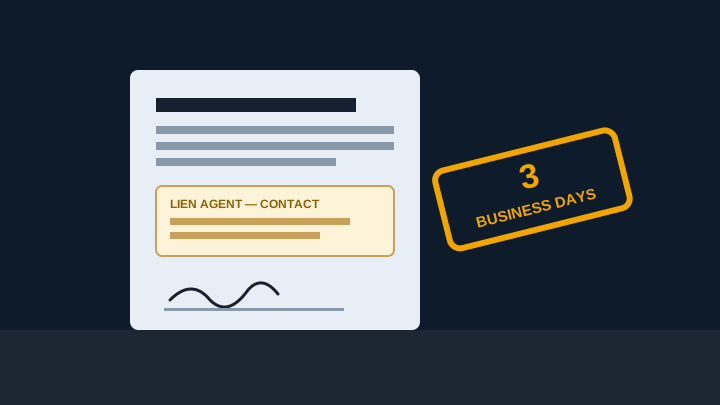
Here is the duty most likely to be tested on your projects: under § 44A-11.1, a contractor or subcontractor that contracts with a lower-tier subcontractor must give that lower-tier party WRITTEN notice of the designated lien agent’s contact information within THREE BUSINESS DAYS of contracting. Three business days — from signing, not from notice to proceed, not from mobilization. In practice the clean solution is structural: put the lien agent’s identity and contact block directly into your subcontract template, so the duty is satisfied in the same signature that creates it. A sub who signs on Tuesday and first hears of the lien agent in a job-trailer conversation three weeks later has been failed by the paperwork — and the failure is on the party above them in the chain.
Authority: N.C.G.S. § 44A-11.1
The permit counter: § 87-14(a1)
The licensing chapter reinforces the relay at the permit desk. Under G.S. § 87-14(a1) — the same statute that makes the permit applicant prove licensure and workers’ compensation coverage — an applicant for a building permit for an improvement of $40,000 or more must furnish the designated lien agent’s contact information to the building inspector, the agent having been designated under § 44A-11.1(a), with exceptions tracking the single-family-residence carve-out. Note the design after S.L. 2023-108: the licensure threshold (§ 87-1), the permit-proof threshold (§ 87-14), and the lien-agent designation threshold (§ 44A-11.1(a)) all sit at the same $40,000, having been moved there together by one act effective October 1, 2023. One number, three statutes, one project-setup conversation. The Board itself confirmed this alignment to GC Prep in writing in 2026 — and it is the second reason your permit-desk paperwork should have the lien agent’s details ready before you apply.
Authority: N.C.G.S. § 87-14(a1) · N.C.G.S. § 44A-11.1 · S.L. 2023-108 (H.B. 488), s. 2(h) · N.C.G.S. § 87-1 · N.C.G.S. § 87-14
The notice to lien agent — § 44A-11.2
Now flip to the claimant’s side of the mailbox. Section 44A-11.2 provides the mechanism by which potential lien claimants — the general contractor included — give the lien agent notice of their involvement in the project. The notice identifies the claimant and its role, so that the central record of who is on the project builds in real time. This is the payoff of the whole system: when the property later sells or refinances, the owner and the title insurer consult the lien agent’s record to see who might hold claims, and claimants who noticed early are visible and protected in that process. The practical rule for a contractor is simple and cheap: get your notice to the lien agent in early — through the LiensNC platform this is a routine electronic filing — and make it part of project mobilization, not something remembered when payment slows. Early notice costs minutes; being the invisible claimant at a closing can cost the claim.
Authority: N.C.G.S. § 44A-11.2
Worked example — the relay in days
Count the relay in calendar squares. Monday the 3rd: the owner designates a registered lien agent and pulls the permit for a $95,000 tenant upfit, furnishing the agent’s contact information to the inspector under § 87-14(a1). Tuesday the 4th: you sign the electrical subcontractor — your three-business-day written notice of the agent’s contact information is due by Friday the 7th, and because your subcontract template carries the agent block, it went out with the signature. Wednesday the 5th: your electrician files its notice to the lien agent; the project record now shows a claimant nobody would have found by looking at the deed. Friday the 7th: the electrician signs its own low-voltage sub, and its own three-day clock starts. Every link is cheap, dated, and provable — which is exactly what makes the system work when payment later slows.
Authority: N.C.G.S. § 87-14(a1)
Posting and the paper trail
The lien-agent information is also meant to be visible at the project itself — the designation details accompany the building permit documentation, conspicuous where inspections happen, so that any tradesperson on site can find the notice address without asking the owner’s lawyer. For you, the takeaway is a checklist: (1) confirm the owner designated a registered agent before first contract; (2) capture the agent’s contact block into your subcontract template; (3) meet the three-business-day written-notice duty for every lower-tier signing, every time; (4) file your own § 44A-11.2 notice early through LiensNC; (5) keep proof — dated transmittals, the signed subcontracts carrying the agent block, and your notice confirmations — in the project file. Every item is inexpensive. Every item is difficult to reconstruct after a dispute has started.
Authority: N.C.G.S. § 44A-11.2
Traducción de cortesía — la versión en inglés es la oficial del curso.
Un sistema que solo funciona si la dirección viaja
Un agente de gravámenes designado no sirve de nada a un proveedor que nunca ha oído hablar de él. Por eso los estatutos no se detienen en la designación — construyen un relevo. El propietario nombra al agente; los datos del nombramiento deben entonces viajar hacia abajo por la cadena hasta cada parte cuyos futuros derechos de gravamen dependen de saber a dónde enviar el aviso. Este módulo trata de ese relevo: su deber como contratista de transmitir la información hacia abajo, el papel del sistema de permisos en publicarla, y qué hace un posible reclamante con la dirección una vez que la tiene. En la mayoría de las obras el contratista general es el eje del relevo — lo que convierte estos plazos breves en asunto suyo.
Su deber de tres días hábiles
Este es el deber que con más probabilidad se pondrá a prueba en sus obras: bajo el § 44A-11.1, un contratista o subcontratista que contrate con un subcontratista de nivel inferior debe dar a esa parte de nivel inferior aviso ESCRITO de la información de contacto del agente de gravámenes designado dentro de TRES DÍAS HÁBILES desde la contratación. Tres días hábiles — desde la firma, no desde la orden de proceder, no desde la movilización. En la práctica la solución limpia es estructural: incorpore la identidad y el bloque de contacto del agente de gravámenes directamente en su plantilla de subcontrato, de modo que el deber quede satisfecho con la misma firma que lo crea. Un subcontratista que firma un martes y se entera del agente de gravámenes por primera vez en una conversación en la caseta de obra tres semanas después ha sido defraudado por el papeleo — y la falla es de la parte que está por encima de él en la cadena.
El mostrador de permisos: § 87-14(a1)
El capítulo de licencias refuerza el relevo en el mostrador de permisos. Bajo el G.S. § 87-14(a1) — el mismo estatuto que obliga al solicitante del permiso a acreditar licencia y cobertura de compensación laboral — quien solicite un permiso de construcción para una mejora de $40,000 o más debe proporcionar al inspector de construcción la información de contacto del agente de gravámenes designado, habiendo sido dicho agente designado conforme al § 44A-11.1(a), con excepciones que siguen la exclusión de la vivienda unifamiliar. Note el diseño posterior a la S.L. 2023-108: el umbral de licencia (§ 87-1), el umbral de acreditación en el permiso (§ 87-14) y el umbral de designación del agente de gravámenes (§ 44A-11.1(a)) se sitúan todos en los mismos $40,000, habiendo sido llevados allí en conjunto por una sola ley con vigencia desde el 1 de octubre de 2023. Una cifra, tres estatutos, una sola conversación de preparación de obra. La propia Junta confirmó esta alineación a GC Prep por escrito en 2026 — y es la segunda razón por la que su papeleo del mostrador de permisos debería tener listos los datos del agente de gravámenes antes de presentar la solicitud.
El aviso al agente de gravámenes — § 44A-11.2
Pasemos ahora al lado del reclamante frente al buzón. La sección 44A-11.2 establece el mecanismo por el cual los posibles reclamantes de gravamen — incluido el contratista general — dan aviso al agente de gravámenes de su participación en la obra. El aviso identifica al reclamante y su papel, de modo que el registro central de quién está en la obra se construye en tiempo real. Ese es el beneficio de todo el sistema: cuando la propiedad se venda o refinancie más adelante, el propietario y la aseguradora de títulos consultan el registro del agente de gravámenes para ver quién podría tener reclamaciones, y los reclamantes que avisaron temprano quedan visibles y protegidos en ese proceso. La regla práctica para un contratista es simple y barata: presente temprano su aviso al agente de gravámenes — a través de la plataforma LiensNC es una presentación electrónica rutinaria — y hágalo parte de la movilización de obra, no algo que se recuerda cuando el pago se demora. El aviso temprano cuesta minutos; ser el reclamante invisible en un cierre puede costar la reclamación.
Ejemplo práctico — el relevo contado en días
Cuente el relevo en casillas de calendario. Lunes 3: el propietario designa un agente de gravámenes registrado y saca el permiso para una adecuación de local de $95,000, proporcionando al inspector la información de contacto del agente conforme al § 87-14(a1). Martes 4: usted firma con el subcontratista eléctrico — su aviso escrito de tres días hábiles con la información de contacto del agente vence el viernes 7, y como su plantilla de subcontrato lleva el bloque del agente, salió con la firma. Miércoles 5: su electricista presenta su aviso al agente de gravámenes; el registro de la obra muestra ahora un reclamante que nadie habría encontrado mirando la escritura. Viernes 7: el electricista firma con su propio subcontratista de bajo voltaje, y comienza su propio plazo de tres días. Cada eslabón es barato, fechado y demostrable — que es exactamente lo que hace funcionar al sistema cuando el pago se demora más adelante.
La publicación y el rastro documental
La información del agente de gravámenes también debe estar visible en la obra misma — los datos de la designación acompañan la documentación del permiso de construcción, en lugar visible donde ocurren las inspecciones, para que cualquier trabajador en el sitio pueda encontrar la dirección de aviso sin preguntarle al abogado del propietario. Para usted, la conclusión es una lista de verificación: (1) confirme que el propietario designó un agente registrado antes del primer contrato; (2) incorpore el bloque de contacto del agente a su plantilla de subcontrato; (3) cumpla el deber de aviso escrito de tres días hábiles en cada firma de nivel inferior, siempre; (4) presente temprano su propio aviso del § 44A-11.2 a través de LiensNC; (5) conserve la prueba — remisiones fechadas, los subcontratos firmados que llevan el bloque del agente, y sus confirmaciones de aviso — en el expediente de la obra. Cada punto es económico. Cada punto es difícil de reconstruir una vez comenzada una disputa.
Authority & state references
- N.C.G.S. § 44A-11.1 — Lien agent; designation and duties ⏱ ≈ 6 min read
- N.C.G.S. § 44A-11.2 — Identification of lien agent; notice to lien agent; effect of notice ⏱ ≈ 5 min read
- N.C.G.S. § 87-14(a1) — Regulations as to issue of building permits — subsection (a1), lien agent disclosure ⏱ ≈ 2 min read
Tap any citation to read it in the statute reader without leaving this page — about 13 minutes of authority reading is available in this module. Time spent here is instructional time: use it if you want more depth, or if you need additional minutes toward the 100-minute course requirement.
Official text opens on the North Carolina General Assembly site (ncleg.gov) — the source of record for every citation. Read-time figures are estimates.
Independent contractor-education provider. Not affiliated with, endorsed by, or acting for the North Carolina Licensing Board for General Contractors. Education, not legal advice — verify current statutes with the NC General Assembly.