MODULE 8 OF 8 · 20 MIN
Course Review & Final Assessment
Learning objectives
- Consolidate the regulatory, consumer-protection, and business/law material.
- Complete the graded, untimed, security-controlled end-of-course assessment.
Lesson
What you now know
Walk the arc once more, and notice as you do that it is an arc — each module handed its conclusion to the next. You can name your regulator (DPOR) and your rule-maker (the Board for Contractors), and you know where the statute (Title 54.1, Chapter 11) and the regulation (18 VAC 50-22) live — and, from Module 1's deep dive, how to read a citation and pull the official text yourself. You know the $1,000 licensing floor and the three classes under the September 2025 amendments — C to just under $30,000 per project, B from $30,000 to just under $150,000, A at $150,000+ (or $1M+ per 12 months) with no upper limit — the labor-plus-materials math that measures a project against its ceiling, and the people-in-roles behind every licensed firm: responsible management, the qualified individual, the designated employee. You know the license lifecycle: complete honest applications (disclose and explain — always), 60-day reporting for a changed qualified individual, biennial renewal on your own calendar because the duty is yours whether the notice arrives or not. You know the Standards of Practice and the Prohibited Acts as two sides of one page: real written contracts, project money applied to the project, permits pulled and inspections called, supervision you can prove, no unjustified 30-day silences, nothing untrue said to anyone — and you know the disciplinary process well enough to respond on time, in writing, with the file. You know the consumer framework: required contract contents, the 3-business-day home-solicitation cancellation right, and the Recovery Fund with its judgment-first, 12-month, capped mechanics — funded by you, backed by your license. And you know the business layer that keeps all of it standing: entity shields you must respect to keep, the more-than-two-workers compensation trigger, honest worker classification, 7-day prompt payment down, and the 90-day lien clock with its enforcement window up. That is not eight separate subjects. It is one subject — how a Virginia contracting business runs clean — taught eight ways.
The assessment — what to expect
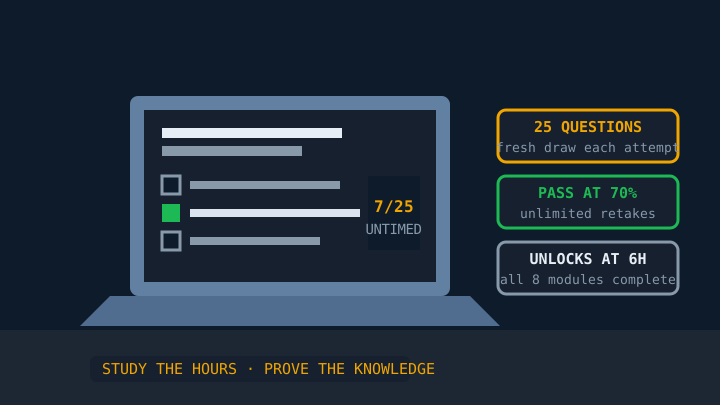
The end-of-course assessment unlocks once every module is complete and your six instructional hours are recorded — check the time chip in the toolbar, which now shows both your credited and recorded time. Know the shape of it so there are no surprises: it is untimed, drawn fresh from a large pool, presented one question at a time, and you may submit whenever you choose. Unanswered questions score as incorrect, 70 percent passes, and you may retake with a fresh draw as many times as you need. Read that policy again and notice what it tells you about the assessment's purpose: it verifies completion — that the last six hours actually landed — rather than ranking you or trying to trick you. There is no clock pressure, no penalty for a careful pace, and no reason for anxiety: approach it as confirmation of the work you have already done. That said, give it honest preparation, because the material is the material Virginia holds you responsible for on day one of your license. If a module's content feels soft, reread it — the module checks are a fast diagnostic: rerun any check you cannot pass cold, read the explanations under the answers, and play the module's reinforcement games, which teach the same facts from a different angle and credit your instructional time besides. The questions ahead are drawn from exactly what you have read: the numbers, the deadlines, the roles, the rules of conduct. If you can explain the arc in the section above to another contractor, you are ready.
After you pass
On passing with the course complete, you will confirm the legal name for your certificate exactly as it appears on your government ID — it cannot be changed afterward except through support@gcprep.app, because a completion record that can be casually edited is not a record at all — and you may add your Virginia DMV control number to help match your record. Your certificate, completion ID, and recorded hours become your completion record: keep them with the license-application file Module 3 taught you to build, because that is precisely where they belong — the education component of the qualification package, filed next to the entity papers, the experience documentation, and the financial showing. Then go do the things. Build the application from Module 3, deliberately and completely, disclosure explanations drafted calm. Pick the class from Module 2 that your next twelve months of real work honestly requires. Set up the business from Module 7 — the entity respected, the insurance certificates current, the crew classified honestly, the lien deadlines calendared. Run every job on Module 4's standards and Module 6's consumer framework: the written contract, the change orders, the project ledger, the bad news delivered early. And stay off Module 5's docket the boring way — with a checklist posted where estimates get written. This course ends; the record it produced and the habits it taught are meant to outlast it. Good luck — and build well.
Optional deep dive — from certificate to application, mapped OPTIONAL
Here is how the last six hours convert into your next moves, mapped course-to-application. Your completion record — certificate, completion ID, recorded hours — is the education component; file it with the application papers from Module 3's checklist. Your class decision comes from Module 2's math: price your next twelve months of real work against the $30,000 and $150,000 lines and pick the class that work honestly requires, remembering that Class A and B add examinations through the Board's testing provider. Your people come from Module 2's roles: know who is responsible management, who is the qualified individual, who is the designated employee — even if all three are you. Your paperwork discipline comes from Modules 3 and 7: the license file, the renewal calendar with its 90/60/30 reminders, and the job files that will someday answer a complaint before it becomes one. Your conduct rails come from Modules 4 and 5: real contracts, project money on the project, permits and inspections, no unjustified silences, nothing untrue to anyone. And your customer framework comes from Module 6: required contract contents, the cancellation window, change orders in writing. The final assessment confirms you know this; the application, and every job after it, is where you prove it.

Authority: 18 VAC 50-22 · Va. Code Title 54.1, Ch. 11
Traducción de cortesía — la versión en inglés es la oficial del curso.
Lo que ahora sabe
Recorra el arco una vez más, y note al hacerlo que es un arco — cada módulo entregó su conclusión al siguiente. Puede nombrar a su regulador (DPOR) y a quien hace sus reglas (la Junta de Contratistas), y sabe dónde viven el estatuto (Título 54.1, Capítulo 11) y el reglamento (18 VAC 50-22) — y, gracias al análisis a fondo del Módulo 1, cómo leer una cita y extraer el texto oficial usted mismo. Conoce el piso de $1,000 para el licenciamiento y las tres clases bajo las enmiendas de septiembre de 2025 — la C hasta justo por debajo de $30,000 por proyecto, la B desde $30,000 hasta justo por debajo de $150,000, la A en $150,000+ (o $1M+ por cada 12 meses) sin límite superior — la cuenta de mano de obra más materiales que mide un proyecto contra su techo, y las personas-en-roles detrás de cada empresa licenciada: la gerencia responsable, el individuo calificado, el empleado designado. Conoce el ciclo de vida de la licencia: solicitudes completas y honestas (divulgar y explicar — siempre), el reporte en 60 días de un cambio de individuo calificado, la renovación bienal según su propio calendario porque el deber es suyo llegue o no el aviso. Conoce las Normas de Práctica y los Actos Prohibidos como dos caras de una misma página: contratos reales por escrito, el dinero del proyecto aplicado al proyecto, permisos tramitados e inspecciones solicitadas, supervisión que pueda probar, sin silencios injustificados de 30 días, nada falso dicho a nadie — y conoce el proceso disciplinario lo bastante bien como para responder a tiempo, por escrito, con el expediente. Conoce el marco del consumidor: los contenidos obligatorios del contrato, el derecho de cancelación de 3 días hábiles en ventas a domicilio, y el Fondo de Recuperación con su mecánica de sentencia-primero, 12 meses y tope — financiado por usted, respaldado por su licencia. Y conoce la capa de negocio que mantiene todo en pie: los escudos de la entidad que debe respetar para conservarlos, el detonante de compensación de más de dos trabajadores, la clasificación honesta de los trabajadores, el pago puntual de 7 días por abajo, y el reloj de 90 días del gravamen con su ventana de ejecución por arriba. Eso no son ocho materias separadas. Es una sola materia — cómo funciona limpiamente un negocio de contratación en Virginia — enseñada de ocho maneras.
La evaluación — qué esperar
La evaluación de fin de curso se desbloquea una vez que cada módulo está completo y sus seis horas de instrucción están registradas — revise el chip de tiempo en la barra de herramientas, que ahora muestra tanto su tiempo acreditado como el registrado. Conozca su forma para que no haya sorpresas: no tiene tiempo límite, se extrae fresca de un banco grande, se presenta una pregunta a la vez, y usted puede enviarla cuando decida. Las preguntas sin responder se califican como incorrectas, se aprueba con 70 por ciento, y puede repetirla con un nuevo sorteo tantas veces como necesite. Lea esa política de nuevo y note lo que le dice sobre el propósito de la evaluación: verifica la finalización — que las últimas seis horas de verdad se asentaron — en lugar de clasificarlo a usted o intentar engañarlo. No hay presión de reloj, ni penalización por un ritmo cuidadoso, ni razón para la ansiedad: abórdela como confirmación del trabajo que ya realizó. Dicho esto, prepárela con honestidad, porque el material es el material del que Virginia lo hace responsable el primer día de su licencia. Si el contenido de un módulo se siente flojo, reléalo — las verificaciones de módulo son un diagnóstico rápido: vuelva a hacer cualquier verificación que no pueda aprobar en frío, lea las explicaciones bajo las respuestas, y juegue los juegos de refuerzo del módulo, que enseñan los mismos hechos desde otro ángulo y además acreditan su tiempo de instrucción. Las preguntas que vienen se extraen exactamente de lo que ha leído: los números, los plazos, los roles, las reglas de conducta. Si puede explicar el arco de la sección anterior a otro contratista, está listo.
Después de aprobar
Al aprobar con el curso completo, confirmará el nombre legal para su certificado exactamente como aparece en su identificación oficial — no puede cambiarse después salvo a través de support@gcprep.app, porque un registro de finalización que pueda editarse a la ligera no es un registro en absoluto — y puede agregar su número de control del DMV de Virginia para ayudar a hacer coincidir su expediente. Su certificado, su ID de finalización y sus horas registradas se convierten en su registro de finalización: guárdelos con el expediente de solicitud de licencia que el Módulo 3 le enseñó a armar, porque ahí es precisamente donde pertenecen — el componente educativo del paquete de calificación, archivado junto a los papeles de la entidad, la documentación de experiencia y la comprobación financiera. Luego vaya a hacer las cosas. Arme la solicitud del Módulo 3, deliberada y completamente, con las explicaciones de divulgación redactadas con calma. Elija la clase del Módulo 2 que sus próximos doce meses de trabajo real honestamente requieran. Ponga en marcha el negocio del Módulo 7 — la entidad respetada, los certificados de seguro vigentes, la cuadrilla clasificada con honestidad, los plazos de gravamen en el calendario. Maneje cada obra según las normas del Módulo 4 y el marco del consumidor del Módulo 6: el contrato escrito, las órdenes de cambio, el libro contable del proyecto, las malas noticias entregadas temprano. Y manténgase fuera del expediente del Módulo 5 por la vía aburrida — con una lista de verificación pegada donde se redactan los presupuestos. Este curso termina; el registro que produjo y los hábitos que enseñó están hechos para durar más que él. Buena suerte — y construya bien.
Análisis a fondo opcional — del certificado a la solicitud, mapeado
Así es como las últimas seis horas se convierten en sus próximos pasos, mapeadas del curso a la solicitud. Su registro de finalización — certificado, ID de finalización, horas registradas — es el componente educativo; archívelo con los papeles de solicitud de la lista de verificación del Módulo 3. Su decisión de clase proviene de la cuenta del Módulo 2: ponga precio a sus próximos doce meses de trabajo real contra las líneas de $30,000 y $150,000 y elija la clase que ese trabajo honestamente requiera, recordando que las Clases A y B agregan exámenes a través del proveedor de exámenes de la Junta. Su gente proviene de los roles del Módulo 2: sepa quién es la gerencia responsable, quién es el individuo calificado, quién es el empleado designado — aunque los tres sean usted. Su disciplina de papeleo proviene de los Módulos 3 y 7: el expediente de la licencia, el calendario de renovación con sus recordatorios de 90/60/30, y los expedientes de obra que algún día responderán una queja antes de que se convierta en una. Sus rieles de conducta provienen de los Módulos 4 y 5: contratos reales, el dinero del proyecto en el proyecto, permisos e inspecciones, sin silencios injustificados, nada falso dicho a nadie. Y su marco de cliente proviene del Módulo 6: los contenidos obligatorios del contrato, la ventana de cancelación, las órdenes de cambio por escrito. La evaluación final confirma que sabe esto; la solicitud, y cada obra después de ella, es donde lo demuestra.
Authority & state references
- 18 VAC 50-22 — Board for Contractors Regulations (full chapter)
- Va. Code Title 54.1, Ch. 11 — Contractors (Code of Virginia, Title 54.1, Chapter 11)
Official text opens on the Virginia Law Portal (law.lis.virginia.gov).
REINFORCE IT — COUNTS TOWARD YOUR 6 HOURS
Lock in this module with a quick round — fresh puzzles daily. Completing a game here credits 15 minutes toward your instructional time (once per game per day). Launch the games from this button so the credit counts.
Independent contractor-education provider. Not affiliated with, endorsed by, or acting for the Virginia Board for Contractors or DPOR. GC Prep does not issue or grant a contractor license. Verify all requirements with DPOR.