MODULE 3 OF 8 · 35 MIN
Applying, Maintaining & Renewing a License
Learning objectives
- Walk the application path: pre-license education, exam, experience, fees.
- Explain renewal cycle, reinstatement, and reporting changes to the Board.
- Identify what must be kept current to avoid a lapse.
Lesson
The license lifecycle
A Virginia contractor license is not a one-time event — it is a lifecycle: apply, qualify, hold, renew, and, if you slip, reinstate. This module walks that lifecycle end to end, and it is worth stating plainly why it deserves a module at all. Nearly every way contractors get into administrative trouble comes down to one of two failures: a date missed or a change unreported. Not incompetence, not dishonesty — a renewal that arrived while the firm was busiest, a resigned qualified individual nobody told the Board about, an address change that meant the notice went to the old shop. The Board runs on paperwork and deadlines because paperwork and deadlines are how a regulator supervises thousands of firms it cannot visit; your side of the bargain is a handful of dates and duties that fit on one page. Learn the machinery here and two things happen: Modules 4 and 5 — the conduct rules — become much easier to stay on the right side of, because half the 'accidental' violations there begin as lifecycle slips; and your license stops being a source of background anxiety, because every obligation it carries is on a calendar you control. The theme throughout, worth adopting as a company value: the Commonwealth never surprises a contractor who writes things down.
Assembling the application
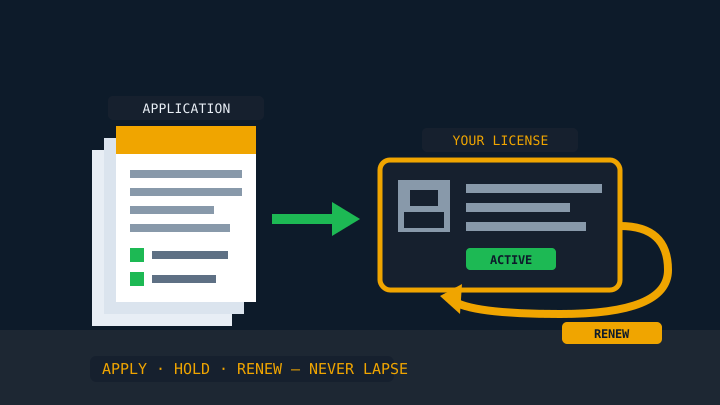
Whatever class you pursue, the application package tells the Board the same story from four angles: who controls the firm (responsible management, with background disclosures for each), who qualifies it technically (your qualified individual and their documented experience), whether the firm is financially sound for its class, and whether the education and examination requirements are met — this course being the education component. Understand that the four angles are one question asked four ways: can this firm be trusted with Virginians' homes and money? Answer it like an application engineer. Entity papers first, matching exactly — the LLC name on the formation documents, the application, and the insurance certificates must be the same string of characters, because mismatched names are the classic bounce. People next: every member of responsible management drafts their disclosure answers calmly, in advance, with explanations attached where history needs context. Experience third: the qualified individual's verifiable history — dates, employers, project types, references who still answer the phone — assembled now, while the evidence is fresh. Money last: financial documentation appropriate to your class, pulled current, not from last year's loan file. Practical counsel from the pattern of real applications: order your documentation before you order your business cards. An application that goes in complete moves; one that bounces for missing items can cost you a season of work — and a season of work is worth more than every fee on the form. Current forms and fee amounts live on DPOR's site; always pull the live version rather than trusting a stale copy, including any copy in this course.
Authority: 18 VAC 50-22-100
Honesty on the application
Every question on the application is answered under penalty, and this section exists because the disclosure questions — prior discipline, criminal history, judgments, prior license actions — are where good applicants make their worst decisions. Here is the calculus the nervous applicant gets wrong. They imagine the choice is between 'clean application, license granted' and 'disclosed history, license denied.' The real choice is different: disclosure questions are evaluated in context, and an imperfect history honestly disclosed is routinely workable — boards read explanations, weigh time elapsed, and license people with old judgments and old charges every cycle. A clean-looking application that conceals something is not workable: as Module 5 covers, a false or misleading statement to the Board is itself a prohibited act, independent of whatever was being hidden — meaning the concealment converts a probably-surmountable history into a fresh, unsurmountable violation, discovered at the worst possible time by the body deciding your future. And discovery is the norm, not the exception: the questions exist because the answers are checkable. So the operating rule is absolute: when in doubt, disclose and explain. Write the explanation like a professional — what happened, when, what you did about it, what has changed — and attach it. The Board has seen everything; what it has not forgiven is being lied to on the form that begins the relationship.
Holding the license — the duty to keep the Board current
Licensure is not fire-and-forget. The license the Board issued describes a specific firm — these owners, this qualified individual, this address, this entity — and changes in your firm must be reported to the Board on its clock, not yours. The anchor example: a change of the qualified individual must be reported within 60 days. Understand why this one gets a hard number: the qualified individual IS the firm's technical qualification — when they leave, the factual basis of your license walked out the door, and the Board gives you sixty days to restore it, not forever to mention it. Changes to your business address, entity structure, or responsible management carry their own reporting duties with their own windows — check the current requirements when any change happens, because an unreported change can quietly invalidate the assumptions your license was issued on, and 'quietly' is the dangerous part: the firm keeps operating, jobs keep closing, and the problem surfaces only when something else goes wrong and an investigator compares the license file to reality. The habit that catches all of it costs nothing: any time something changes on your letterhead — name, address, people, structure — ask in the same breath what DPOR needs to know about it. Assign that question to your license-compliance owner (the renewal-support section below makes that a named job), and the duty to keep the Board current becomes a fifteen-minute task instead of a disciplinary exhibit.
Authority: 18 VAC 50-22-140
Renewal, lapse, and reinstatement
Virginia contractor licenses renew on a two-year cycle. DPOR mails or emails renewal notices, but — and this is the sentence to memorize — the duty to renew on time is yours whether or not the notice reaches you. The notice is a courtesy; the deadline is the law. Calendar it independently, the day the license is issued. Now walk what actually happens when the date slips, because the consequences arrive in stages and each stage is worse. Renew late and you enter the reinstatement window: higher fees, more process — annoying but survivable. The real damage is the gap: work performed while lapsed is unlicensed work, with everything Module 5 attaches to that — and it is unlicensed work performed by a contractor who believes, sincerely, that everything is fine. Every contract signed in the gap, every draw taken, every permit pulled carries the problem. Let the reinstatement window pass entirely and the license is simply gone: you start over as a new applicant, with the application, the qualifications showing, and the wait — while your competitors keep bidding. Against all of that, the defense is a recurring calendar reminder that takes ninety seconds to create. The cheapest insurance in this entire course is that reminder, set the day your license is issued, on a calendar your business actually reads.
Authority: 18 VAC 50-22-150
Renewal support — build the reminder system now
Turn the renewal rule into a system while it is fresh. Three habits cover nearly every lapse story the Board sees: first, the day your license is issued, calendar the expiration date with reminders at 90, 60, and 30 days out — on a calendar your company actually reads, not a drawer with DPOR's postcard in it. Second, name one person who owns license compliance — renewals, address and qualified-individual changes, and Board correspondence — so 'somebody' is a job title, not a hope. Third, keep a single license file: application, license certificate, renewal receipts, insurance and bond certificates. When a renewal, a bid form, or a Board question asks for proof, you answer from one folder instead of an archaeology dig. GC Prep's free Virginia renewal reference gathers the renewal cadence, fee references, and reinstatement rules on one page you can bookmark as the backbone of that system — but a reminder tool is support, not a substitute: the duty to renew on time stays with the licensee.
Authority: 18 VAC 50-22-140 · 18 VAC 50-22-170
Open the free Virginia renewal reference → GC Prep tool — renewal cadence, fees, and reinstatement references for Virginia, on one bookmarkable page.
Deadlines that follow the work itself
Two statutory clocks from later modules deserve an early preview, because they run alongside the license lifecycle and share its lesson: the date is the right. First, payment flowing down. Under Virginia's Prompt Payment framework, a general contractor who is paid must pay subcontractors within 7 days of receiving payment for their work. When you are the GC, that is a duty with a number on it — the owner's draw hitting your account starts a seven-day clock on your subs' share. When you are the sub, it is a right with a number on it — and knowing the number changes the collection conversation. Second, payment flowing up. The mechanic's lien — your strongest collection tool, covered fully in Module 7 — must be recorded within 90 days after your last day of work, and a suit to enforce it must follow within the statutory window, generally six months from recording. Ninety days feels long in July and arrives fast in October: invoices get re-sent, promises get made, and the deadline passes while everyone is being polite. Miss those windows and the remedy is simply gone — not weakened, gone; no court can revive an unrecorded lien. So adopt the discipline now, before Module 7 gives you the details: the day an invoice goes unpaid, calendar the 90-day date. Contractors who survive treat legal deadlines the way they treat concrete cure times — non-negotiable, indifferent to excuses, and set the moment the pour happens.
Optional deep dive — the application file, document by document OPTIONAL
Build the file before you need it and the application becomes an afternoon instead of a season. Entity papers: your formation documents and any trade-name registration, matching — exactly — the name you will put on the application, because mismatched names are a classic bounce. People: for each member of responsible management, the background and disclosure answers with any supporting explanation drafted calmly in advance, not composed in a panic at the deadline. Experience: for your qualified individual, a verifiable work history — dates, employers, project types — assembled while the references still answer the phone. Money: the financial documentation appropriate to your class, pulled fresh. Education and exams: this course's completion record, and for Class A and B the examination results from the Board's testing provider. Then the two habits that keep the file alive after licensure: every renewal receipt and every piece of Board correspondence goes into the same folder, and every change in the firm triggers the question from the lesson — what does DPOR need to know, and by when? A firm that can produce its license file on request has also, not coincidentally, already answered most of what a renewal, a bid form, or an investigator will ever ask.

Authority: 18 VAC 50-22-100
Traducción de cortesía — la versión en inglés es la oficial del curso.
El ciclo de vida de la licencia
Una licencia de contratista de Virginia no es un evento único — es un ciclo de vida: solicitar, calificar, mantener, renovar y, si se descuida, reinstalar. Este módulo recorre ese ciclo de principio a fin, y vale la pena decir sin rodeos por qué merece un módulo entero. Casi todas las formas en que los contratistas se meten en problemas administrativos se reducen a una de dos fallas: una fecha que se pasó o un cambio que no se reportó. No incompetencia, no deshonestidad — una renovación que venció mientras la empresa estaba más ocupada, un empleado calificado que renunció y nadie le avisó a la Junta, un cambio de dirección que hizo que el aviso llegara al taller antiguo. La Junta funciona con papeleo y plazos porque el papeleo y los plazos son la manera en que un regulador supervisa a miles de empresas que no puede visitar; su parte del trato es un puñado de fechas y deberes que caben en una sola página. Aprenda el mecanismo aquí y ocurren dos cosas: los Módulos 4 y 5 — las reglas de conducta — se vuelven mucho más fáciles de cumplir, porque la mitad de las infracciones 'accidentales' que hay allí empiezan como descuidos del ciclo de vida; y su licencia deja de ser una fuente de ansiedad de fondo, porque cada obligación que conlleva está en un calendario que usted controla. El tema de fondo, que vale la pena adoptar como valor de la empresa: el Estado nunca sorprende a un contratista que anota las cosas.
Armar la solicitud
Cualquiera que sea la clase que persiga, el paquete de solicitud le cuenta a la Junta la misma historia desde cuatro ángulos: quién controla la empresa (la gerencia responsable, con divulgaciones de antecedentes de cada persona), quién la califica técnicamente (su empleado calificado y su experiencia documentada), si la empresa es financieramente sólida para su clase, y si se cumplen los requisitos de educación y examen — siendo este curso el componente de educación. Entienda que los cuatro ángulos son una sola pregunta hecha de cuatro maneras: ¿se puede confiar a esta empresa los hogares y el dinero de los habitantes de Virginia? Respóndala como un ingeniero de solicitudes. Los papeles de la entidad primero, coincidiendo exactamente — el nombre de la LLC en los documentos de constitución, la solicitud y los certificados de seguro deben ser la misma cadena de caracteres, porque los nombres que no coinciden son el rebote clásico. Las personas después: cada miembro de la gerencia responsable redacta sus respuestas de divulgación con calma, por adelantado, con explicaciones adjuntas cuando la historia necesite contexto. La experiencia en tercer lugar: la historia verificable del empleado calificado — fechas, empleadores, tipos de proyecto, referencias que todavía contesten el teléfono — reunida ahora, mientras la evidencia esté fresca. El dinero al final: la documentación financiera apropiada para su clase, obtenida al día, no del archivo de préstamo del año pasado. Consejo práctico según el patrón de solicitudes reales: ordene su documentación antes de ordenar sus tarjetas de presentación. Una solicitud que entra completa avanza; una que rebota por faltar elementos puede costarle una temporada de trabajo — y una temporada de trabajo vale más que todas las tarifas del formulario juntas. Los formularios y montos de tarifas vigentes están en el sitio de DPOR; obtenga siempre la versión en vivo en lugar de confiar en una copia desactualizada, incluida cualquier copia en este curso.
Honestidad en la solicitud
Cada pregunta de la solicitud se responde bajo pena de ley, y esta sección existe porque las preguntas de divulgación — disciplina previa, antecedentes penales, sentencias, acciones previas sobre licencias — son donde los buenos solicitantes toman sus peores decisiones. He aquí el cálculo que el solicitante nervioso hace mal. Imagina que la elección es entre 'solicitud limpia, licencia otorgada' e 'historia divulgada, licencia denegada'. La verdadera elección es distinta: las preguntas de divulgación se evalúan en contexto, y una historia imperfecta divulgada con honestidad es rutinariamente manejable — las juntas leen explicaciones, sopesan el tiempo transcurrido y otorgan licencia a personas con sentencias antiguas y cargos antiguos en cada ciclo. Una solicitud de apariencia limpia que oculta algo no es manejable: como cubre el Módulo 5, una declaración falsa o engañosa a la Junta es en sí misma un acto prohibido, independiente de lo que se estuviera ocultando — es decir, el ocultamiento convierte una historia probablemente superable en una infracción nueva e insuperable, descubierta en el peor momento posible por el mismo organismo que decide su futuro. Y el descubrimiento es la norma, no la excepción: las preguntas existen porque las respuestas son verificables. Así que la regla operativa es absoluta: ante la duda, divulgue y explique. Escriba la explicación como un profesional — qué pasó, cuándo, qué hizo al respecto, qué ha cambiado — y adjúntela. La Junta lo ha visto todo; lo que no ha perdonado es que le mientan en el formulario que inicia la relación.
Mantener la licencia — el deber de tener a la Junta al día
La obtención de la licencia no es cosa de una vez y olvidar. La licencia que emitió la Junta describe una empresa específica — estos dueños, este empleado calificado, esta dirección, esta entidad — y los cambios en su empresa deben reportarse a la Junta según su reloj, no el suyo. El ejemplo ancla: un cambio del empleado calificado debe reportarse dentro de 60 días. Entienda por qué este lleva un número duro: el empleado calificado ES la calificación técnica de la empresa — cuando se va, la base fáctica de su licencia se marchó por la puerta, y la Junta le da sesenta días para restaurarla, no todo el tiempo del mundo para mencionarlo. Los cambios en la dirección de su negocio, la estructura de la entidad o la gerencia responsable llevan sus propios deberes de reporte con sus propias ventanas — verifique los requisitos vigentes cuando ocurra cualquier cambio, porque un cambio no reportado puede invalidar en silencio las suposiciones sobre las que se emitió su licencia, y 'en silencio' es la parte peligrosa: la empresa sigue operando, los trabajos siguen cerrándose, y el problema aparece solo cuando algo más sale mal y un investigador compara el expediente de la licencia con la realidad. El hábito que atrapa todo esto no cuesta nada: cada vez que algo cambia en su membrete — nombre, dirección, personas, estructura — pregunte en el mismo momento qué necesita saber DPOR al respecto. Asigne esa pregunta a su responsable de cumplimiento de licencias (la sección de apoyo a la renovación más abajo lo convierte en un puesto con nombre), y el deber de tener a la Junta al día se vuelve una tarea de quince minutos en lugar de una prueba disciplinaria.
Renovación, caducidad y reinstalación
Las licencias de contratista de Virginia se renuevan en un ciclo de dos años. DPOR envía por correo o correo electrónico los avisos de renovación, pero — y esta es la frase que hay que memorizar — el deber de renovar a tiempo es suyo, llegue o no el aviso. El aviso es una cortesía; el plazo es la ley. Póngalo en su calendario de forma independiente, el día en que se emite la licencia. Ahora recorra lo que realmente sucede cuando la fecha se pasa, porque las consecuencias llegan por etapas y cada etapa es peor. Renueve tarde y entra en la ventana de reinstalación: tarifas más altas, más trámite — molesto pero superable. El verdadero daño es la brecha: el trabajo realizado mientras está caducada es trabajo sin licencia, con todo lo que el Módulo 5 le adjunta a eso — y es trabajo sin licencia realizado por un contratista que cree, sinceramente, que todo está bien. Cada contrato firmado en la brecha, cada anticipo cobrado, cada permiso obtenido carga con el problema. Deje pasar la ventana de reinstalación por completo y la licencia simplemente desaparece: usted empieza de cero como nuevo solicitante, con la solicitud, la demostración de calificaciones y la espera — mientras sus competidores siguen ofertando. Contra todo eso, la defensa es un recordatorio recurrente de calendario que toma noventa segundos crear. El seguro más barato de todo este curso es ese recordatorio, puesto el día en que se emite su licencia, en un calendario que su negocio realmente consulta.
Apoyo a la renovación — construya el sistema de recordatorios ahora
Convierta la regla de renovación en un sistema mientras está fresca. Tres hábitos cubren casi todas las historias de caducidad que ve la Junta: primero, el día en que se emite su licencia, ponga en el calendario la fecha de vencimiento con recordatorios a 90, 60 y 30 días de anticipación — en un calendario que su empresa realmente consulta, no en un cajón con la postal de DPOR adentro. Segundo, nombre a una persona que sea dueña del cumplimiento de la licencia — renovaciones, cambios de dirección y de empleado calificado, y correspondencia con la Junta — para que 'alguien' sea un puesto, no una esperanza. Tercero, mantenga un solo expediente de licencia: solicitud, certificado de licencia, recibos de renovación, certificados de seguro y de fianza. Cuando una renovación, un formulario de oferta o una pregunta de la Junta pidan pruebas, usted responde desde una sola carpeta en lugar de una excavación arqueológica. La referencia gratuita de renovación de Virginia de GC Prep reúne el ritmo de renovación, las referencias de tarifas y las reglas de reinstalación en una sola página que puede guardar como marcador y usar como columna vertebral de ese sistema — pero una herramienta de recordatorio es un apoyo, no un sustituto: el deber de renovar a tiempo sigue siendo del licenciatario.
Plazos que siguen al trabajo mismo
Dos relojes legales de módulos posteriores merecen un adelanto temprano, porque corren en paralelo al ciclo de vida de la licencia y comparten su lección: la fecha manda. Primero, el pago que fluye hacia abajo. Bajo el marco de Pago Puntual (Prompt Payment) de Virginia, un contratista general que recibe pago debe pagar a los subcontratistas dentro de 7 días de recibir el pago por su trabajo. Cuando usted es el contratista general, eso es un deber con un número — el anticipo del dueño que entra a su cuenta arranca un reloj de siete días sobre la parte de sus subcontratistas. Cuando usted es el subcontratista, es un derecho con un número — y conocer el número cambia la conversación de cobro. Segundo, el pago que fluye hacia arriba. El gravamen del constructor — su herramienta de cobro más fuerte, cubierta por completo en el Módulo 7 — debe registrarse dentro de 90 días después de su último día de trabajo, y una demanda para hacerlo valer debe seguir dentro de la ventana legal, generalmente seis meses desde el registro. Noventa días se sienten largos en julio y llegan rápido en octubre: se reenvían facturas, se hacen promesas, y el plazo pasa mientras todos están siendo corteses. Pierda esas ventanas y el remedio simplemente desaparece — no se debilita, desaparece; ningún tribunal puede revivir un gravamen no registrado. Así que adopte la disciplina ahora, antes de que el Módulo 7 le dé los detalles: el día en que una factura queda sin pagar, ponga en el calendario la fecha de los 90 días. Los contratistas que sobreviven tratan los plazos legales como tratan los tiempos de curado del concreto — no negociables, indiferentes a las excusas, y fijados en el momento en que se hace la colada.
Profundización opcional — el expediente de solicitud, documento por documento
Arme el expediente antes de necesitarlo y la solicitud se vuelve una tarde en lugar de una temporada. Papeles de la entidad: sus documentos de constitución y cualquier registro de nombre comercial, coincidiendo — exactamente — con el nombre que pondrá en la solicitud, porque los nombres que no coinciden son un rebote clásico. Personas: para cada miembro de la gerencia responsable, las respuestas de antecedentes y divulgación con cualquier explicación de apoyo redactada con calma por adelantado, no compuesta en pánico al vencimiento del plazo. Experiencia: para su empleado calificado, una historia laboral verificable — fechas, empleadores, tipos de proyecto — reunida mientras las referencias todavía contesten el teléfono. Dinero: la documentación financiera apropiada para su clase, obtenida al día. Educación y exámenes: el registro de finalización de este curso, y para Clase A y B los resultados del examen del proveedor de exámenes de la Junta. Luego los dos hábitos que mantienen vivo el expediente después de obtener la licencia: cada recibo de renovación y cada pieza de correspondencia de la Junta va a la misma carpeta, y cada cambio en la empresa dispara la pregunta de la lección — ¿qué necesita saber DPOR, y para cuándo? Una empresa que puede presentar su expediente de licencia cuando se lo pidan también ha respondido ya, no por casualidad, la mayor parte de lo que una renovación, un formulario de oferta o un investigador le preguntarán alguna vez.
Authority & state references
- 18 VAC 50-22-100 — Fees
- 18 VAC 50-22-140 — Renewal fees
- 18 VAC 50-22-150 — Board discretion to deny renewal
Official text opens on the Virginia Law Portal (law.lis.virginia.gov).
REINFORCE IT — COUNTS TOWARD YOUR 6 HOURS
Lock in this module with a quick round — fresh puzzles daily. Completing a game here credits 15 minutes toward your instructional time (once per game per day). Launch the games from this button so the credit counts.
Independent contractor-education provider. Not affiliated with, endorsed by, or acting for the Virginia Board for Contractors or DPOR. GC Prep does not issue or grant a contractor license. Verify all requirements with DPOR.